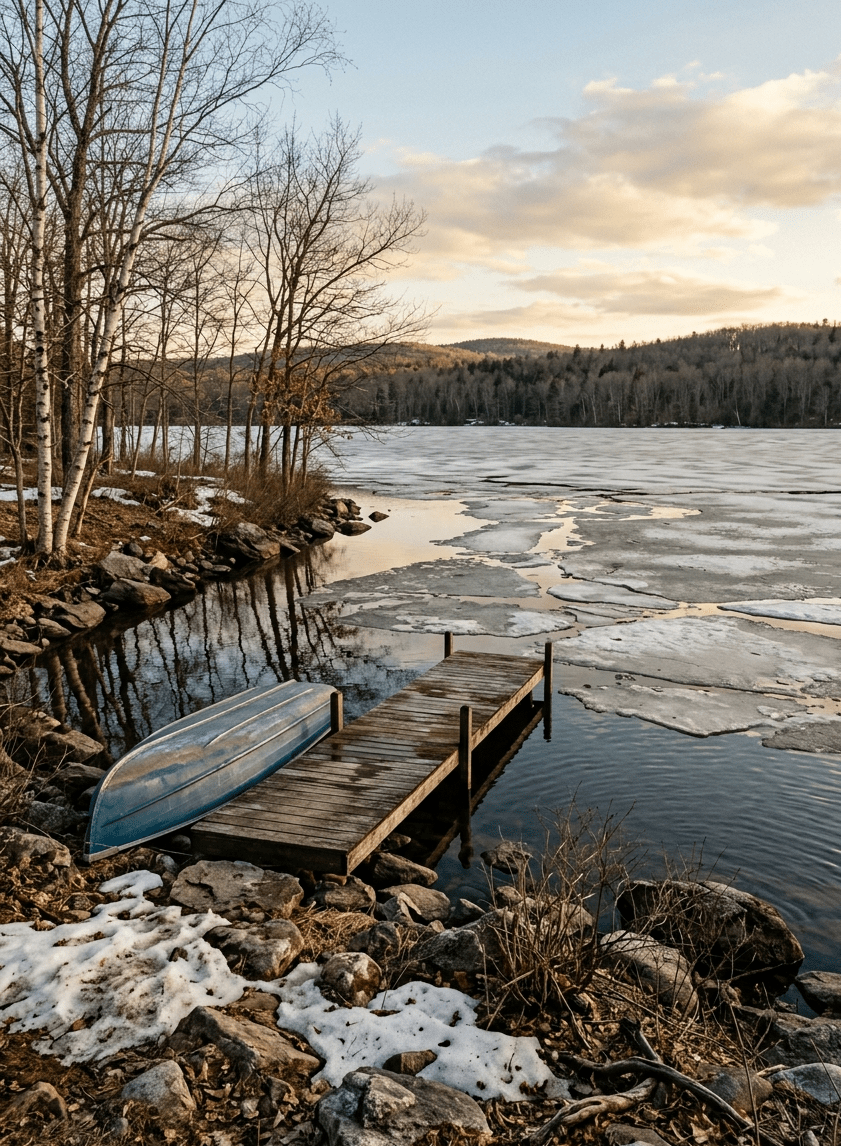
There is a moment every spring in Vermont that does not make the national news, does not trend on social media, and does not come with a lot of fanfare. It is quiet. It is slow. And if you have lived here long enough, you start watching for it sometime in late March with the same low-grade anticipation you might feel waiting for a train that runs on its own schedule.
Ice-out. The lakes are letting go.
If you are new to Vermont or planning your first spring visit, ice-out season is one of those deeply local experiences that sneaks up on you. One day the lake is still a frozen sheet. A week later the edges are soft and dark. And then one morning you look out and the water is moving, and something in your chest loosens right along with it.
What Ice-Out Actually Means in Vermont
Ice-out is not a precise scientific term, though people track it with near-scientific devotion. In the most basic sense, it refers to the point when a lake or pond is clear enough of ice that a boat could navigate freely from one end to the other. That is the traditional definition, and different bodies of water use slightly different standards for when to make the official call.
On some lakes, a local observer makes the determination. On others, it is more informal, a collective agreement among the people who live on the shoreline. Either way, the declaration carries real weight. Ice-out is Vermont’s unofficial starting pistol for spring.
After a winter that can stretch from November into April in the Northeast Kingdom, that moment matters. People who have spent five or six months watching a frozen landscape finally get to see water again. Not snowmelt running down a ditch. Not a muddy creek. Open water, catching light, moving the way it is supposed to move.
The Science Behind the Melt
Vermont lakes typically freeze from the edges inward, with ice thickening through January and February depending on temperatures and snow cover. A heavy snow year can actually insulate the ice and slow the freeze, while a cold, dry winter with clear skies can push ice depth to two feet or more on the bigger lakes.
The melt works in reverse, starting at the shoreline where the water is shallower and where dark ground absorbs more solar energy. By late March, the sun angle has changed enough that even cold days start losing the battle. You will notice the ice pulling away from shore first, leaving a ring of dark open water that widens a little each day.
In the final days before ice-out, the ice goes through a transformation that Vermonters call “candling.” The solid sheet breaks down into vertical crystals that look almost fragile, like a frozen honeycomb. When you tap it, it sounds hollow. When the wind picks up or the rain comes, those crystals collapse in sections and the whole thing disappears faster than you would expect.
Timing varies wildly. In mild years, some ponds see ice-out by the third week of March. In stubborn years, you might be watching chunks drift on Lake Champlain well into April. Climate trends have been nudging ice-out dates earlier over the decades, but Vermont weather has always had a way of doing exactly what it wants regardless of expectations.
Vermont’s Most Watched Ice-Out Lakes
Every lake in Vermont has its own ice-out story, but a few get more attention than others.
Lake Champlain is the big one. Stretching over 100 miles along Vermont’s western border, Champlain does not freeze completely every year, and when it does, the ice tends to come off in stages. The Burlington waterfront is a great place to watch the transition, especially on a clear March afternoon when the Adirondacks are still buried in snow and the lake is starting to move again.
Lake Memphremagog straddles the Vermont-Quebec border in the Northeast Kingdom and has its own ice-out culture. Newport, Vermont sits on the southern tip of the lake, and locals there watch the ice closely every spring. The cross-border nature of the lake adds a quirky dimension to the whole thing.
Joe’s Pond in West Danville is probably the most famous ice-out lake in Vermont, and for good reason. More on that in a moment.
But honestly, some of the best ice-out watching happens on the smaller Kingdom ponds that most visitors never hear about. A quiet pond with a camp on the shore and a pair of mergansers working the newly open water at dawn is its own reward.
Joe’s Pond Ice-Out Contest: Vermont’s Unofficial Spring Lottery
If you want to understand what ice-out means to Vermonters, spend five minutes on the Joe’s Pond Ice-Out Contest website. People enter from all over the country. Vermont expats in Florida and California buy tickets and watch the webcam from their living rooms. The whole thing is wonderfully, authentically Vermont.
Here is how it works. A wooden tripod is set up on the ice at Joe’s Pond each spring. The tripod is connected to a clock onshore by a wire. When the ice softens enough that the tripod sinks or shifts, the wire trips the clock and locks in the official ice-out time down to the minute. Whoever picked the closest date and time in the contest wins.
The contest has been running since 1988 and draws thousands of entries every year. The prize money has grown over the decades, but honestly the prize is almost beside the point. What people are really buying into is the ritual of it, the collective watching, the shared anticipation across hundreds of miles.
You can follow along at joespond.com, and entries are typically available through the winter. If you have never entered, it is worth doing at least once just to have skin in the game when the ice starts to look soft.
What to Do Around Vermont When Ice-Out Arrives
Ice-out is not just a thing to watch. It is a thing to get out and be part of.
Get On the Water
Fishing season reopens with ice-out, and Vermont anglers do not waste any time. The weeks right after ice-out can be some of the best fishing of the year, especially for trout and perch in smaller lakes. Kayaking and canoe season kicks off too, and the early spring crowds are thin. If you have ever wanted to paddle a Vermont lake with no one else around, the window between ice-out and Memorial Day is your window.
Visit the Lakeside Towns
Burlington, St. Albans, Newport, Hardwick. The towns that sit close to water have a different energy in spring. Restaurants and shops that went quiet in the deep winter start reopening their doors. The Church Street Marketplace in Burlington fills back up. The marina in Newport starts prepping boats. There is a slow, optimistic hum to all of it that is genuinely hard not to get caught up in.
Watch for Birds
Ice-out brings the loons back. Common loons overwinter along the coast and return to Vermont’s lakes as soon as open water appears, sometimes before all the ice is even gone. Hearing a loon call across a still spring lake at dusk is one of those Vermont experiences that sounds like a cliche until you actually hear it for the first time. Mergansers, buffleheads, and early migrating ducks also show up right at ice-out, making the shoreline worth watching even if you are not a dedicated birder.
Simply Sit and Watch
This one is underrated. Find a bench, a dock, or a flat rock on the shore and just watch the water. After months of frozen stillness, seeing a lake in motion again is more satisfying than it sounds. There is something almost meditative about it.
Ice-Out as a Vermont State of Mind
If you ask a Vermonter what ice-out means to them, they will probably give you a practical answer first. Fishing opens. You can get the kayak out. The road to the camp is finally passable.
But there is something underneath all of that. Vermont winters are not just cold. They are long. They are dark. By March, even the people who genuinely love winter are ready for something to change. Ice-out is that change made visible. It is the land and water doing what they have done every year since before anyone was here to watch it, letting go of one season and making room for the next.
People who move to Vermont from somewhere else often talk about how quickly they adopt ice-out as their own milestone. It takes about one full winter for that to happen. After a single mud season, after a few weeks of frozen roads and brown slush and a sky that seems permanently gray, you will understand exactly why watching a lake wake up feels like a genuine event.
There is nothing quite like a Vermont spring thaw. Slow, a little messy, and completely worth the wait.
Shop Green Mountain Peaks on Etsy
Bring a little piece of Vermont into your home with our curated collection of gifts, apparel, and seasonal favorites. From cozy hoodies and crewnecks to Vermont-themed gift boxes and cookbooks, each item is designed to celebrate the Green Mountain spirit.
- Vermont-inspired designs and gift sets
- Printed and packaged with care
- Ships directly to your door
Discover gifts, apparel, and Vermont treasures made to share and enjoy year-round.

Leave a comment