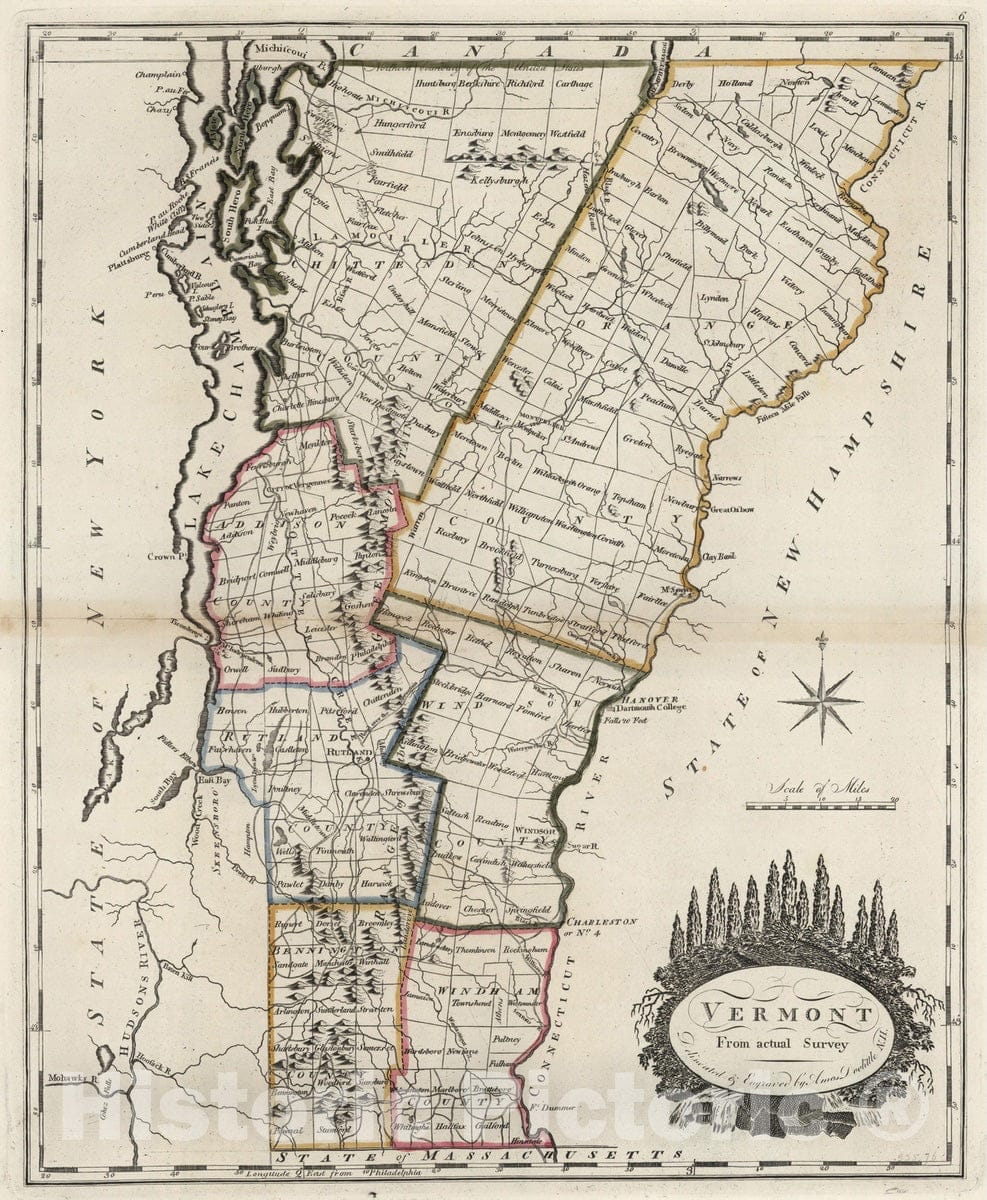
Tucked between the Adirondacks and the White Mountains, Vermont holds a one-of-a-kind place in American history. While most states followed a standard path to statehood, Vermont took an entirely different route. It forged its own identity through revolution, negotiation, and an unwavering sense of independence.
From disputed land claims to a peaceful, condition-free admission into the Union, Vermont’s journey to becoming the 14th state reflects the bold and resilient spirit of the Green Mountains.
🗺️ Before Vermont: A Land Caught in Conflict
In the early 1700s, the region we now know as Vermont was the subject of fierce territorial disputes. Both New York and New Hampshire claimed ownership.
In 1749, New Hampshire’s Royal Governor, Benning Wentworth, began issuing land grants west of the Connecticut River. These became known as the New Hampshire Grants. However, New York insisted that it held jurisdiction over the same territory.
This conflict was more than a legal disagreement. It sparked the rebellious energy that would come to define Vermont’s future.
⚔️ Enter the Green Mountain Boys
As New York attempted to enforce its claims, settlers in the New Hampshire Grants organized a resistance. At the heart of this movement was the Green Mountain Boys, a militia led by Ethan Allen.
These settlers were not just defending land titles. They were protecting the principle of local control and self-governance.
“Come out of there, you damned old rat”
Ethan Allen
The Green Mountain Boys became folk heroes. They symbolized the fierce independence that still defines Vermont today.
🔥 The Revolutionary War and Vermont’s Declaration of Independence
When the American Revolution erupted in 1775, Vermont settlers quickly took up arms against British rule. Ethan Allen and the Green Mountain Boys captured Fort Ticonderoga, providing critical artillery for the Continental Army.
However, Vermont remained in an unusual political limbo. It was not officially recognized as part of any colony or future state.
On January 15, 1777, delegates from across the New Hampshire Grants met in the town of Westminster, Vermont. There, they declared independence not from Britain, but from both New York and New Hampshire. This gathering, known as the Westminster Convention, marked the birth of the Republic of Vermont.
The new republic was initially called New Connecticut. That name was soon changed to Vermont, derived from the French phrase verts monts, meaning “green mountains.”
Later that year, Vermont adopted a constitution that was revolutionary for its time:
- It abolished adult slavery
- It granted voting rights to all men, regardless of property ownership
- It supported public education
For the next 14 years, Vermont operated as a fully independent republic. It had its own postal system, currency, and even conducted foreign diplomacy.
🤝 Why Wasn’t Vermont Immediately Admitted?
You might wonder, if Vermont was so eager, why was it not immediately Despite its democratic values and contributions to the war, Vermont was not welcomed into the Union right away.
New York continued to object to Vermont’s admission, still upset about the earlier land disputes. Some leaders in the Continental Congress also feared that admitting Vermont would encourage other regions to break away and declare independence.
Adding to the tension, Vermont’s political views were more aligned with the anti-slavery northern states. At a time when the balance between North and South was delicate, Vermont seemed politically inconvenient.
Vermont’s leaders did not give up. While maintaining independence, they quietly negotiated behind the scenes. Eventually, Vermont agreed to pay New York thirty thousand dollars to settle its territorial claims. Vermont also signaled that it would align politically with northern states.
With those compromises in place, Vermont’s admission became possible.
📜 March 4, 1791: Vermont Becomes the 14th State
On March 4, 1791, Vermont officially became the 14th state in the United States. It was the first state added after the original 13 colonies.
This moment was historic for several reasons:
- Vermont entered as a free state
- It was the only state, outside of the original 13, to be admitted without any conditions
- It showed that a region could join the Union through peaceful negotiation, not war or conquest
- It proved that independent governments could become part of the United States without giving up their identity
“Vermont was born in controversy, grew up in opposition, and has been nursed in adversity.”
Ira Allen | The Natural and Political History of the State of Vermont (1798)
Today, March 4 is quietly remembered by Vermont historians as a symbolic day that honors the state’s proud and independent spirit.
🏔️ Vermont’s Legacy of Independence
The story of how Vermont joined the Union continues to shape its culture and politics.
Even now, Vermonters value:
- Local control and small government
- Political moderation and pragmatism
- Historical figures like Ethan Allen and the Green Mountain Boys
Whether resisting New York authorities or navigating complex diplomacy, Vermont’s leaders proved that conviction, courage, and patience could achieve statehood without violence.
Drive through Vermont’s scenic roads and you’ll find echoes of its revolutionary spirit in every village green and stone wall.
🌲 Final Thoughts
Vermont’s path to statehood was never just about geography or borders. It was about principles.
From the very beginning, Vermonters believed in freedom, fairness, and self-reliance. Those same values that inspired them to declare independence in 1777 continue to define the state today.
What makes Vermont’s story so remarkable is how it joined the Union. It did not rely on conquest or political favor. Instead, it used diplomacy, persistence, and a deep commitment to its ideals.
More than two centuries later, Vermont stands as a powerful example of how a small, determined republic earned its place in the United States while staying true to its identity.

Leave a comment