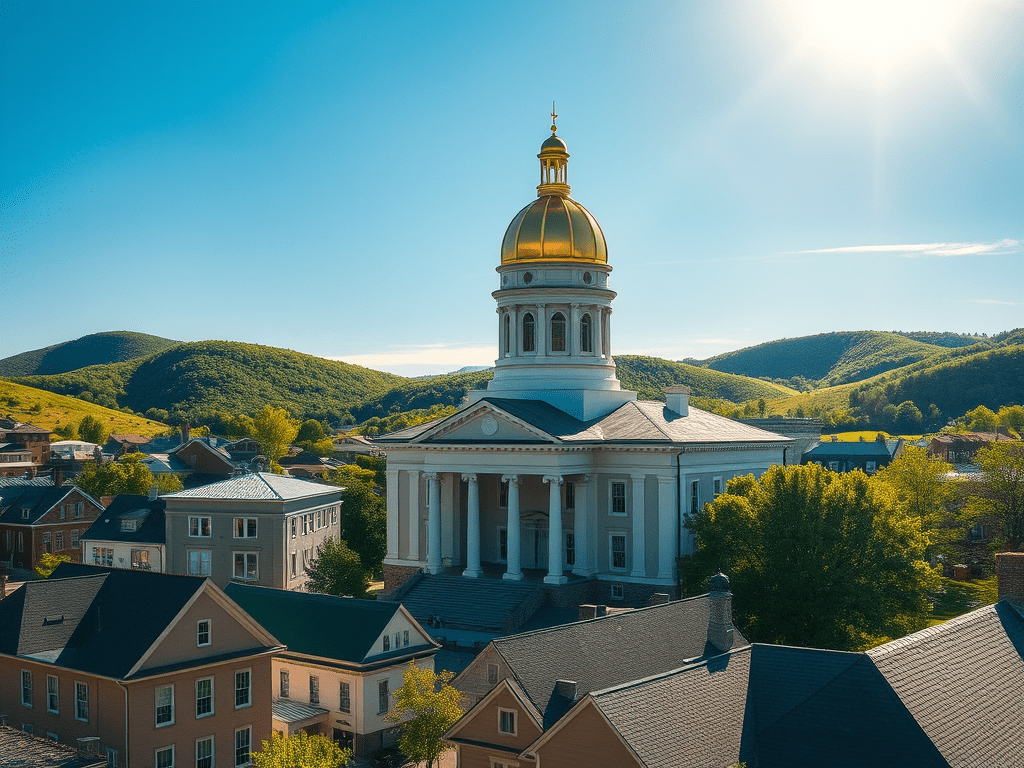
Nestled along the banks of the Winooski River and framed by rolling green hills, Montpelier stands as a charming testament to Vermont’s unique spirit. With a population just shy of 8,000 residents, it holds the title of the smallest state capital in the entire nation. But despite its modest size, Montpelier’s history is anything but small.
A New State Needs a Center
When Vermont officially became the 14th state in 1791, it needed a permanent seat of government. At the time, no single town dominated Vermont’s landscape. Towns like Windsor and Bennington were influential, but settlers were still pushing into the rugged heart of the Green Mountains. Leaders wanted a capital that was geographically central, making it easier for representatives from all corners of the state to meet.
In 1805, after several years of debate, the Vermont legislature chose Montpelier. The decision was largely practical. Montpelier’s central location, its accessibility by early road networks, and a generous offer of land from local citizens helped seal the deal.
At the time, Montpelier was little more than a small village. Once the legislature arrived, though, hotels, inns, shops, and law offices sprang up almost overnight. The town’s transformation from a sleepy river community to the political heart of Vermont had begun.
Why Montpelier and Not Burlington?
Burlington was, and still is, Vermont’s largest city. So why was the bustling lakeside hub overlooked?
There were a few reasons. Burlington was seen as too far north and too heavily focused on commerce instead of politics. Many citizens feared that placing the capital in a commercial city would shift the government’s priorities away from ordinary farmers, who made up most of Vermont’s population. Montpelier’s location closer to the center of the state symbolized fairness and neutrality. Choosing Montpelier sent a message that Vermont’s government was meant to be accessible to everyone, not just the wealthy or powerful.

Building the Statehouse
The first Vermont State House in Montpelier was a modest wooden building completed in 1808. It served its purpose for a time, but as the town and the government grew, so did the need for a grander structure.
By 1833, a new, more impressive State House was built using local granite and featuring a Greek Revival style. Unfortunately, a fire in 1857 destroyed much of that building. Rising from the ashes, Vermont commissioned a third State House, designed by architect Thomas Silloway, which opened in 1859.
Today’s State House, topped with its iconic gold dome, is one of the best-preserved examples of Greek Revival architecture in the United States. It stands as a proud symbol of Vermont’s resilience and commitment to preserving its history.

A Capital That Stays True to Its Roots
Unlike many state capitals that expanded into sprawling cities, Montpelier has kept its small-town charm. There are no major highways cutting through the downtown area, and the skyline remains modest. Even the busiest parts of Montpelier feel personal, cozy, and community-driven.
The people of Montpelier take pride in supporting local businesses, fostering strong community ties, and maintaining a government that feels approachable. You will not find towering skyscrapers or endless stretches of suburbia here. In fact, Montpelier holds another unusual title. It is the only state capital in the United States without a McDonald’s.
This absence is not because Montpelier is anti-fast food. It simply reflects the city’s fierce commitment to keeping things local and preserving its small-town feel. Instead of chain restaurants, you will find independent cafés, bakeries, and restaurants, many of which feature Vermont-grown ingredients.
Montpelier’s small size also means politics stay personal. It is not uncommon to bump into state representatives at the local farmers market, library, or coffee shop. Here, democracy feels much closer to home.
Montpelier’s Role Today
Montpelier is more than just the seat of Vermont’s government. It is a lively center for arts, culture, and activism. The city is home to the Vermont College of Fine Arts, independent galleries, bookstores, and a thriving local food scene.
It is also known for its civic engagement. Montpelier consistently ranks among the highest in the country for voter turnout and community activism. Whether it is an Independence Day parade, a rally on the State House lawn, or the whimsical “March of the Penguins” parade in the middle of winter, Montpelier finds ways to celebrate both tradition and change.
A Small City with a Big Story
Montpelier’s story proves that influence is not measured by size. This tiny capital helped shape a state known for its independent spirit, strong sense of community, and political innovation. From early debates over statehood to modern efforts to protect the environment and promote social justice, Montpelier has stood firmly at the center of Vermont’s story.
It may be the smallest state capital in the nation, but its heart, its history, and its impact are larger than life.

Leave a comment