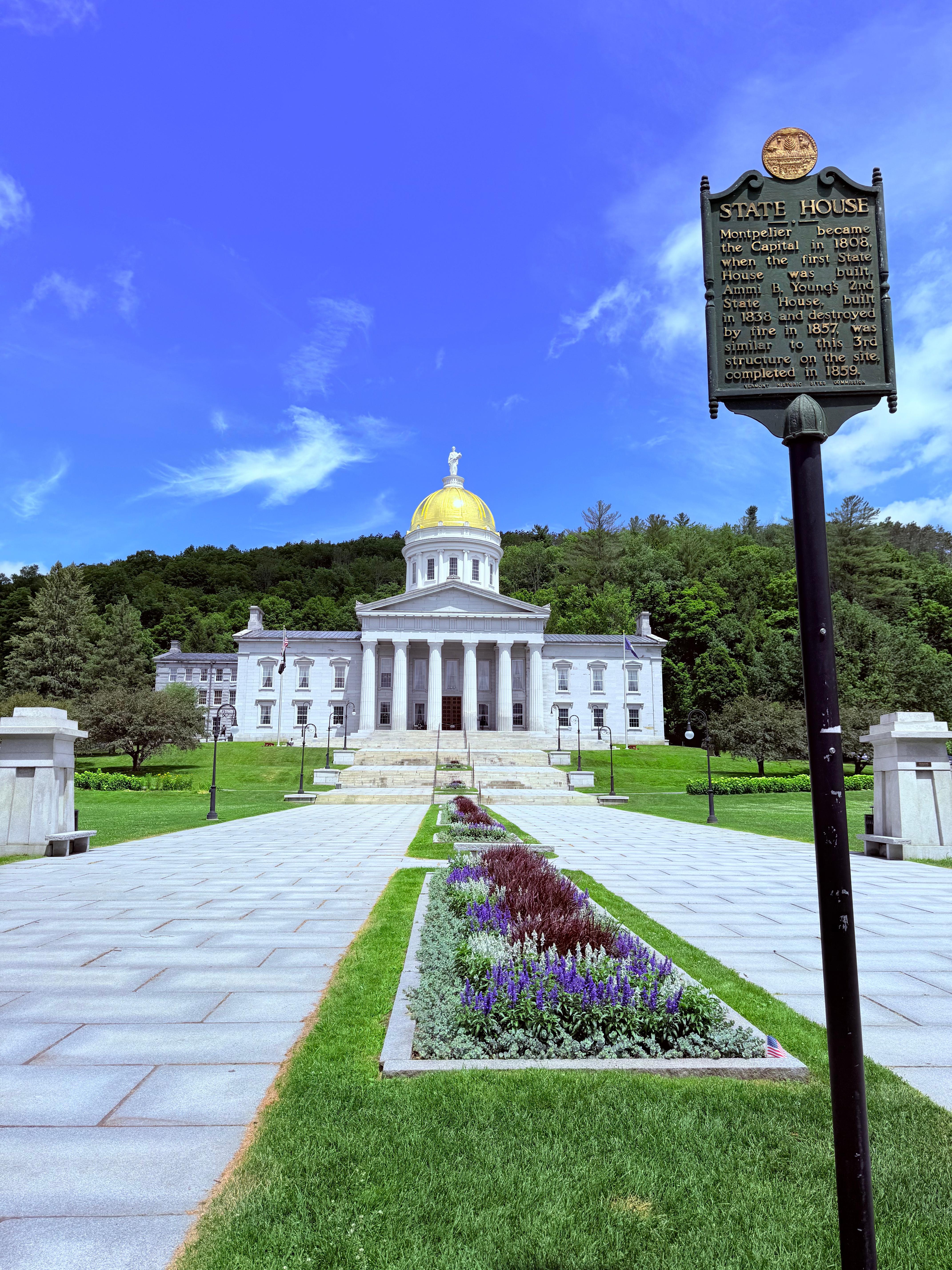
Short answer: Montpelier became Vermont’s capital in 1805 because of its central location. Lawmakers wanted a seat of government every part of the state could reach by road, and they chose a neutral town over Burlington, the state’s largest and most commercial city.
Nestled along the banks of the Winooski River and framed by rolling green hills, Montpelier stands as a charming testament to Vermont’s unique spirit. With about 8,000 residents (8,074 in the 2020 Census), it holds the title of the smallest state capital in the entire nation. But despite its modest size, Montpelier’s history is anything but small.
Montpelier at a Glance
- Population: 8,074 (2020 Census)
- County: Washington County
- Capital since: 1805
- State House: the current building opened in 1859, the third on the same site
- Burlington: about 40 miles west on I-89
Source: U.S. Census Bureau QuickFacts; SAH Archipedia, Vermont State House; distance via Google Maps.
How Montpelier Became the Vermont Capital
When Vermont officially became the 14th state in 1791, it needed a permanent seat of government. At the time, no single town dominated Vermont’s landscape. Towns like Windsor and Bennington were influential, but settlers were still pushing into the rugged heart of the Green Mountains. Leaders wanted a capital that was geographically central, making it easier for representatives from all corners of the state to meet.
In 1805, after several years of debate, the Vermont legislature chose Montpelier. The decision was largely practical. Montpelier’s central location, its accessibility by early road networks, and a generous offer of land from local citizens helped seal the deal.
At the time, Montpelier was little more than a small village. Once the legislature arrived, though, hotels, inns, shops, and law offices sprang up almost overnight. The town’s transformation from a sleepy river community to the political heart of Vermont had begun.
Why Montpelier and Not Burlington?
Burlington was, and still is, Vermont’s largest city. So why was the bustling lakeside hub overlooked?
There were a few reasons. Burlington was seen as too far north and too heavily focused on commerce instead of politics. Many citizens feared that placing the capital in a commercial city would shift the government’s priorities away from ordinary farmers, who made up most of Vermont’s population. Montpelier’s location closer to the center of the state symbolized fairness and neutrality. Choosing Montpelier sent a message that Vermont’s government was meant to be accessible to everyone, not just the wealthy or powerful.

Building the Statehouse
The first Vermont State House in Montpelier was a modest wooden building completed in 1808. It served its purpose for a time, but as the town and the government grew, so did the need for a grander structure.
By 1833, a new, more impressive State House was built using local granite and featuring a Greek Revival style. Unfortunately, a fire in 1857 destroyed much of that building. Rising from the ashes, Vermont commissioned a third State House, designed by architect Thomas Silloway, which opened in 1859.
Today’s State House, topped with its iconic gold dome, is one of the best-preserved examples of Greek Revival architecture in the United States. It stands as a proud symbol of Vermont’s resilience and commitment to preserving its history.

A Capital That Stays True to Its Roots
Unlike many state capitals that expanded into sprawling cities, Montpelier has kept its small-town charm. There are no major highways cutting through the downtown area, and the skyline remains modest. Even the busiest parts of Montpelier feel personal, cozy, and community-driven.
The people of Montpelier take pride in supporting local businesses, fostering strong community ties, and maintaining a government that feels approachable. You will not find towering skyscrapers or endless stretches of suburbia here. In fact, Montpelier holds another unusual title. It is the only state capital in the United States without a McDonald’s.
This absence is not because Montpelier is anti-fast food. It simply reflects the city’s fierce commitment to keeping things local and preserving its small-town feel. Instead of chain restaurants, you will find independent cafés, bakeries, and restaurants, many of which feature Vermont-grown ingredients.
Montpelier’s small size also means politics stay personal. It is not uncommon to bump into state representatives at the local farmers market, library, or coffee shop. Here, democracy feels much closer to home.
Montpelier’s Role Today
Montpelier is more than just the seat of Vermont’s government. It is a lively center for arts, culture, and activism. The city is home to the Vermont College of Fine Arts, independent galleries, bookstores, and a thriving local food scene.
It is also known for its civic life. Whether it is the Independence Day celebration downtown or a rally on the State House lawn, Montpelier finds ways to celebrate both tradition and change.
Visiting Montpelier, Vermont Today
Montpelier is small enough to see on foot in an afternoon, and most of what’s worth doing sits within a few blocks of the State House.
The State House. Start here. The building is open to visitors, and you can see the House and Senate chambers and the portraits and history inside. The lawn out front is where Montpelier gathers for everything from rallies to summer concerts.
Vermont History Museum. Right next door, run by the Vermont Historical Society, it covers the state’s story from the Abenaki through the present. It pairs well with everything you just read above.
Hubbard Park. Just behind the State House, this hillside park has wooded trails and a stone observation tower. Climb it for a view over the rooftops and the gold dome toward the surrounding hills.
Downtown. State Street and Main Street are lined with independent shops, cafés and restaurants, including Bear Pond Books and the Savoy Theater, a small independent cinema. Hunger Mountain Co-op is the place to stock up on Vermont-made food.
Morse Farm Maple Sugarworks. A short drive up County Road from downtown, this family sugarhouse is one of the easiest places near the capital to see how Vermont maple syrup is made.
What It’s Like to Live in Montpelier
Living in Montpelier means a walkable downtown, a strong local food scene and a small-city pace, with Interstate 89 at the edge of town. Waterbury and Stowe are a short drive away, and Burlington is under an hour. For many people moving to Vermont, it’s the balance they’re looking for: real community without giving up easy access to the rest of the state.
Housing costs run above the state average. The Census Bureau puts the median value of an owner-occupied home in Montpelier at $349,200, compared with $290,500 for Vermont as a whole. Median gross rent is $1,169 a month, and about 55% of homes are owner-occupied, against 73% statewide.
Source: U.S. Census Bureau QuickFacts, American Community Survey 2019 to 2023 estimates.
Thinking about living in central or northern Vermont? Start with my guide: Moving to Vermont: A Guide to Living in Northern Vermont. Questions about a specific town? Ask me anything about living in Vermont.
A Small City with a Big Story
Montpelier’s story proves that influence is not measured by size. This tiny capital helped shape a state known for its independent spirit, strong sense of community, and political innovation. From early debates over statehood to modern efforts to protect the environment and promote social justice, Montpelier has stood firmly at the center of Vermont’s story.
It may be the smallest state capital in the nation, but its heart, its history, and its impact are larger than life.
Montpelier, Vermont FAQ
When did Montpelier become the capital of Vermont?
The legislature chose Montpelier in 1805, and lawmakers moved into the first State House there in 1808.
Why isn’t Burlington the capital of Vermont?
Burlington sits in the far northwest of the state and was seen as too focused on commerce. Lawmakers wanted a central, neutral seat of government instead.
Is Montpelier the smallest state capital?
Yes. With 8,074 residents in the 2020 Census, Montpelier is the smallest state capital in the United States by population.
How do you pronounce Montpelier?
Locals say mont-PEEL-yer, with the stress on the middle syllable. It is spelled with one L, unlike the French city of Montpellier.
What is the largest city in Vermont?
Burlington, with about 44,700 residents in the 2020 Census, more than five times the size of Montpelier.
Where was Vermont’s capital before Montpelier?
Vermont had no permanent capital. The legislature moved between towns such as Windsor and Bennington until it settled on Montpelier.
What is Montpelier, Vermont known for?
Its gold-domed State House, being the smallest state capital in the country, and a walkable downtown full of independent shops and restaurants. It is also the only state capital without a McDonald’s.
Is Montpelier worth visiting?
Yes, especially as an easy half day. You can tour the State House, visit the Vermont History Museum, climb the tower in Hubbard Park and eat downtown, all without moving the car. It also sits right off I-89, so it fits neatly into a trip to Stowe or Burlington.
Source: U.S. Census Bureau QuickFacts, 2020 Census.
Leave a Reply