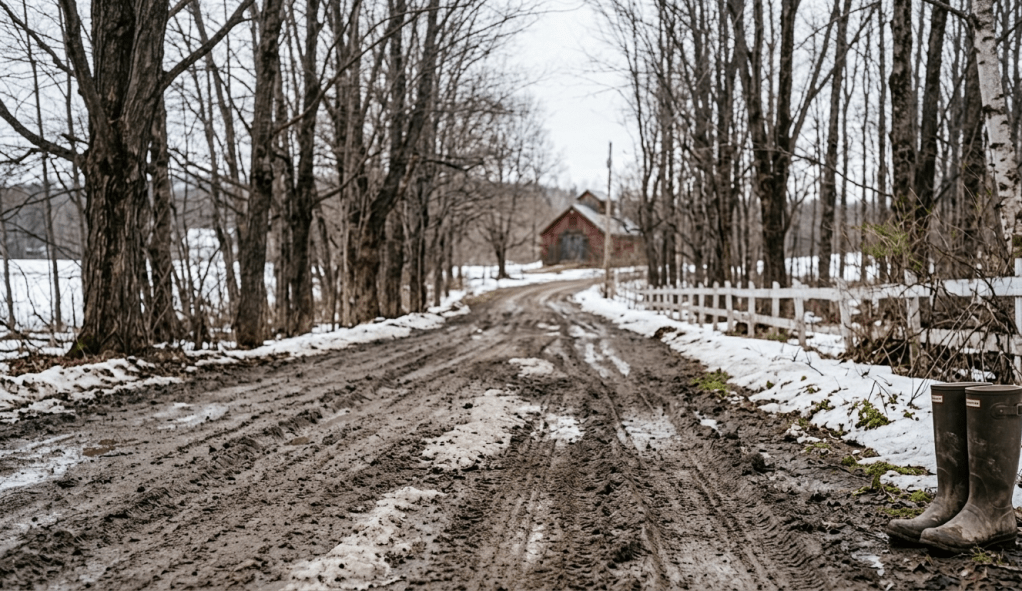
Nobody puts mud season on a tourism brochure. There are no Instagram filters designed to flatter a rutted dirt road in late March, and you will not find a boutique hotel marketing itself as the perfect place to watch your boots disappear into April clay. And yet here we are, because if you want to understand Vermont, actually understand it, you need to know this season. It is as much a part of the place as the foliage or the first snowfall.
Right now, if you are reading this from somewhere in Vermont, there is a decent chance it is 60 degrees outside and you are starting to feel hopeful. The windows are cracked. Someone nearby is wearing a t-shirt. Do not be fooled. This is fake spring, and Vermont does it every year. A warm stretch arrives in early March, convinces everyone that the hard part is over, and then winter comes back for one last word. Real mud season is close, but it is not quite here yet.
Vermont has five seasons. Anyone who has lived here for more than a calendar year knows this without needing it explained. There is a gap between winter and spring that does not belong to either one, and that gap has a name, a personality, and a particular smell you will recognize for the rest of your life once you have been through it.
Vermont Has Five Seasons and Mud Season Is the Realest One
True mud season typically runs from late March through late April, though elevation and year-to-year weather patterns shift it around. What we are in right now, the 60-degree days that feel like a gift, is the warm-up act. Fake spring is real and it is welcome, but the ground is still frozen underneath, the frost has not finished heaving, and the dirt roads have not yet done their worst. That comes next.
What defines mud season is not just the mud itself. It is the particular feeling of being between two things. Winter has lost its grip but spring has not fully committed. The landscape looks tired. The snow that is left is gray and crusted and sulking in the shadowed corners of fields. The ground underneath is doing something complicated involving ice and water and geology that results, at the surface level, in mud.
Locals have layered feelings about this season. There is relief that winter is loosening. There is impatience for the green. There is a low-grade fatigue from months of cold and dark that makes April feel both promising and maddening depending on the hour. It is honest in a way the prettier seasons are not.
What the Ground Is Actually Doing
Frost Heaves, Soft Shoulders, and the Physics of the Thaw
Vermont soil freezes deep in winter, sometimes several feet down. When temperatures start climbing in late winter and early spring, the ground thaws from the top down, not from the bottom up. That means the surface layer softens and saturates with meltwater while the frozen layer beneath it blocks drainage. The result is a surface that looks solid and behaves like a sponge.
Frost heaves are what happen when water in the soil freezes, expands, and pushes the ground surface upward unevenly. On paved roads, you feel them as sudden bumps and dips that seem to appear overnight and then vanish by June. On dirt roads, the whole surface can become corrugated and buckled in ways that no amount of grading entirely fixes until the ground stabilizes.
Vermont has a formal response to this: road posting. Each spring, many towns restrict heavy vehicle traffic on dirt roads during the muddy period to prevent serious damage to the road base. Posted roads are signed, and the weight limits are real. Locals know which roads get posted and plan accordingly.
Dirt Roads in Mud Season: A Special Category of Experience
If you drove a Vermont dirt road in October and loved how it felt, pastoral and quiet and lined with stone walls, come back in April and you will drive a completely different road. The same stretch of packed gravel that felt firm under your tires in autumn can pull at your steering wheel and try to redirect your car in early spring.
Ruts form where tires repeatedly track through softened road base. Soft shoulders can drop away unexpectedly. Puddles form that are deeper than they look. The locals who live on dirt roads develop an almost intuitive knowledge of where the worst spots are and when the surface is firm enough to trust.
There is also an unspoken etiquette around this. If you get stuck, someone will usually stop and help. If you are driving a low-clearance vehicle and eyeing a posted road, the local knowledge is: do not. There is no shame in going around.
What Mud Season Looks Like Day to Day
The Morning vs. Afternoon Split
One of the defining features of mud season is how differently the same day can feel at 7 in the morning versus 2 in the afternoon. Early mornings are often frozen. The ground is firm, the mud from yesterday has a crust on it, and the air is cold enough that you briefly wonder if winter changed its mind. Then the sun gets to work.
By early afternoon on a warm mud-season day, that same ground is soft and giving. Trails that were hikeable at dawn become a different story by midday. Dirt roads that felt solid in the morning are rutting up by the time the school buses run. You start timing your outdoor plans around the temperature in a way you do not have to in any other season.
This daily split also affects maple season, which runs alongside mud season on the same schedule. The overnight freeze and afternoon thaw that softens the roads is exactly the same pattern that moves sap through the trees. The mud and the maple are doing the same thing at the same time for the same meteorological reason.
Your Boots, Your Car, Your Floors
Mud boots are not a suggestion in April. They are the correct footwear the way snowshoes are correct footwear for a February trail. Tall, waterproof, easy to pull off at the door. The brands people swear by up here get worn into the ground and then replaced without ceremony because they earn every mile.
The mud room exists because of mud season. In older Vermont farmhouses, the entry is a small room between outside and inside specifically designed to contain what comes in on your boots before it reaches the kitchen floor. Newer construction often includes the same idea under different names. In April, you understand exactly why.
The mud itself is worth describing. It is not the thin, sandy mud of a summer rain. Vermont mud season mud is heavier and stickier, clay-rich in a lot of areas, the kind that holds the impression of your boot long after you have moved on. It gets into the wheel wells of your car and dries there. It migrates into the house in ways that seem to defy the laws of containment. You learn to accept it as a seasonal roommate and show it the door in May.
The Emotional Weather of Mud Season
Fake spring plays a specific psychological trick on everyone here. The warm days arrive and your whole nervous system relaxes. You think about putting away the heavy coat. You make plans that assume the cold is finished. And then it snows on April 3rd and you remember where you live. The whiplash is real, and it is such a consistent part of the Vermont spring experience that locals have stopped being surprised by it. Mildly annoyed, yes. Surprised, no.
There is a particular kind of tiredness that arrives in March after a real Vermont winter. The cold has been long. The days were short for months. You have worn the same rotation of heavy coats since November and you are ready to be done. Mud season does not offer the clean break you were hoping for. It offers more waiting, dressed up in different weather.
This is the emotional core of the season. You know spring is coming. You can feel it in the light, longer every day, stronger on the south sides of hills. But the mud and the gray skies and the bare trees make it hard to fully believe. You are in between, and being in between is its own kind of hard.
Vermonters handle this in various ways. Some lean into productivity, the mud-season to-do list of garage cleanouts and gear maintenance. Some go to the sugarhouse. Some just get through it, day by day, watching the forecast and waiting for the peepers. The patience required to live through mud season gracefully is the same patience the state asks of you all winter, just in a different form.
What’s Actually Beautiful About Mud Season (Yes, Really)
The Light Comes Back in a Big Way
By April, the light in Vermont is noticeably different from what it was in January or February. The days are longer in a way you feel in your body. The sun is higher and stronger and it hits the landscape with a warmth that has actual conviction behind it. On a clear April afternoon, the light on a wet field or a bare hillside can stop you mid-stride.
Snow retreats from south-facing slopes first, revealing the first patches of brown and matted grass underneath. North-facing woods stay white longer, creating that half-and-half look that is specific to this exact window of the year. It is not the most conventionally beautiful Vermont landscape, but there is an honesty to it that the postcard versions of this state do not capture.
The Sounds and Smells That Signal Change
The spring peepers arrive in mud season, usually sometime in April, and the first night you hear them feels like a genuine event. These small frogs fill the wetlands and ditches and low areas with a high, pulsing sound that carries surprising distances on still evenings. Locals who have been through many Vermont springs still stop and listen when the peepers start. It means something.
The smell of thawed earth is its own reward. After months of cold air that smells like nothing, the particular scent of wet soil and decaying leaves and the first green things pushing up is one of the most welcome things April delivers. It smells alive. That sounds obvious until you have spent a full Vermont winter waiting for it.
Brooks and streams run high and fast with snowmelt, louder than they are at any other time of year. Red-winged blackbirds return to the marshes. Robins appear on lawns that were buried two weeks ago. These are not subtle signs if you know to look for them, and mud season is when they all come back at once.
Mud Season and Maple Season Are the Same Thing
It is worth saying this directly because it reframes the whole season. Mud season is not something Vermont tolerates in order to get to maple season. They are the same season. The same weather pattern that softens the roads and tests your patience is the exact pattern that runs the sap and fills the sugarhouses with steam and the air with that particular sweetness.
When you drive a muddy back road in late March to reach a sugarhouse, you are not driving through the worst of the season to reach the best of it. You are inside the season entirely, mud and maple together, the same thaw doing two different things at once.
That reframe matters if you are visiting. A mud-season trip to Vermont is not a consolation prize. It is sugaring season. It is open sugarhouses and sugar on snow and sap buckets on trees and steam rising from stacks on hillsides. The mud is just the road you take to get there.
What to Know If You’re Visiting Vermont During Mud Season
What to Pack and How to Plan
Mud season visitors who come prepared have a genuinely good time. The crowds are thin compared to fall or ski season, lodging rates are often lower, and the Vermont you encounter is less polished and more real than what you find in peak tourism windows. There is a particular authenticity to the state in April that rewards the curious and flexible traveler.
- Waterproof boots, tall enough to matter. This is the single most important packing decision you will make.
- Layers, including a genuinely warm mid-layer. Mornings are still cold and the temperature swings within a day are real.
- A flexible itinerary. Trail conditions change fast, and the best mud-season plans have a backup.
- Cash for sugarhouses and farm stands. Many smaller operations appreciate it.
What to Do (And What to Skip)
Mud season is ideal for sugarhouse visits, village walks on paved main streets, covered bridge drives, and any activity that keeps you on firm ground or in warm interiors. A well-chosen scenic drive in April, when the landscape has that raw, undecorated quality, is one of the quieter pleasures the state offers.
What to hold off on: backcountry hiking trails, especially at elevation. Vermont trail stewardship organizations ask visitors and locals alike to stay off soft trails during mud season to prevent the kind of erosion damage that takes years to repair. Respect those closures. The trails will be better in June because people did.
- Do: visit a sugarhouse, walk a village green, drive Route 100 or Route 2 through the hills
- Do: stop at a local diner or café, browse a general store, ask someone how the season is going
- Skip: soft backcountry trails, posted dirt roads in a low-clearance vehicle, rigid schedules
What Mud Season Teaches You About Living Here
People who move to Vermont sometimes underestimate mud season. They have done the math on the winters, bought the snow tires, stacked the firewood. And then April arrives and it is gray and wet and the yard looks like a construction site and the boots by the door are multiplying. It is a real adjustment.
But here is what happens after a few of them. You stop fighting it. You start reading it instead, knowing which roads to trust, which days to take the longer paved route, when the peepers are going to start, what the mud looks like right before it firms up for good. The season becomes legible. And then one morning in late April or early May, you walk outside and the ground is dry and the air is warm and the first green things are actually green and it feels like something you earned.
That first genuinely warm spring day after a full Vermont winter and a full mud season is one of the best days of the year here. It is not subtle. People come outside. Windows go up. There is a collective exhale across the whole state that you can almost hear if you are paying attention. You do not get that day without mud season. That is the trade, and most people who live here will tell you it is worth it.
Shop Green Mountain Peaks on Etsy
Bring a little piece of Vermont into your home with our curated collection of gifts, apparel, and seasonal favorites. From cozy hoodies and crewnecks to Vermont-themed gift boxes and cookbooks, each item is designed to celebrate the Green Mountain spirit.
- Vermont-inspired designs and gift sets
- Printed and packaged with care
- Ships directly to your door
Discover gifts, apparel, and Vermont treasures made to share and enjoy year-round.

Leave a comment