There is a particular moment every March when something in Vermont shifts. The cold is still real, the snowpack is still deep in the woods, and the roads are doing that thing they do where the frost heaves turn your commute into an obstacle course. But something is moving. You can feel it before you can see it, and if you know where to go, you can smell it too.
That smell is maple. Specifically, it is wood smoke and boiling sap rolling out of a sugarhouse stack somewhere on a hillside, drifting down across a field that is still half-covered in tired March snow. It is one of the most distinctly Vermont things there is, and if you have never walked into a working sugarhouse during sugaring season, you are missing one of the state’s quietest and best experiences.
What Maple Season in Vermont Actually Looks Like
Vermont maple season is not a single event on the calendar. It is a weather pattern. Sugar makers are watching for a specific combination: nights that drop below freezing and days that nudge above it. That freeze and thaw cycle is what creates pressure in the maple trees and gets the sap moving. Too cold for too long and nothing happens. Too warm too fast and the season ends early. It is a narrow window, and it is different every year.
In a typical year, the season runs from late February into early April, moving northward as temperatures warm. The southern part of the state tends to go first, and the Northeast Kingdom often finishes last. But weather does not follow a schedule, and every sugar maker will tell you that some of their best runs came when they least expected them.
What makes mid-March feel so alive here is the contrast. The landscape still looks like winter in most directions. The trees are bare. The fields are white or gray. But inside those trees, sap is rising, and somewhere up that dirt road, someone has been awake since before sunrise feeding a fire and watching the evaporator.
Arriving at the Sugarhouse
The Smell Hits You Before You Even Open the Car Door
You will know you are close before you see anything. There is a sweetness in the cold air that is hard to describe to someone who has not encountered it before. It is not candy-sweet or artificial. It is more like warm wood and something faintly caramel, carried on smoke and steam. It settles into your coat and your hair, and you will notice it again hours later.
Then you see the steam. On a good run, a sugarhouse stack pumps a steady white column that catches the low March light. It is visible from a distance, which is part of how people have always known to come closer. Pull into the lot and you will likely find it muddy, rutted, and full of trucks. That is a good sign.
What the Sugarhouse Looks Like Up Close
Vermont sugarhouses come in all kinds. Some are old weathered board-and-batten structures that look like they have been standing since the Civil War. Others are newer metal buildings, practical and efficient. Neither one looks like a tourist attraction, and that is exactly the point.
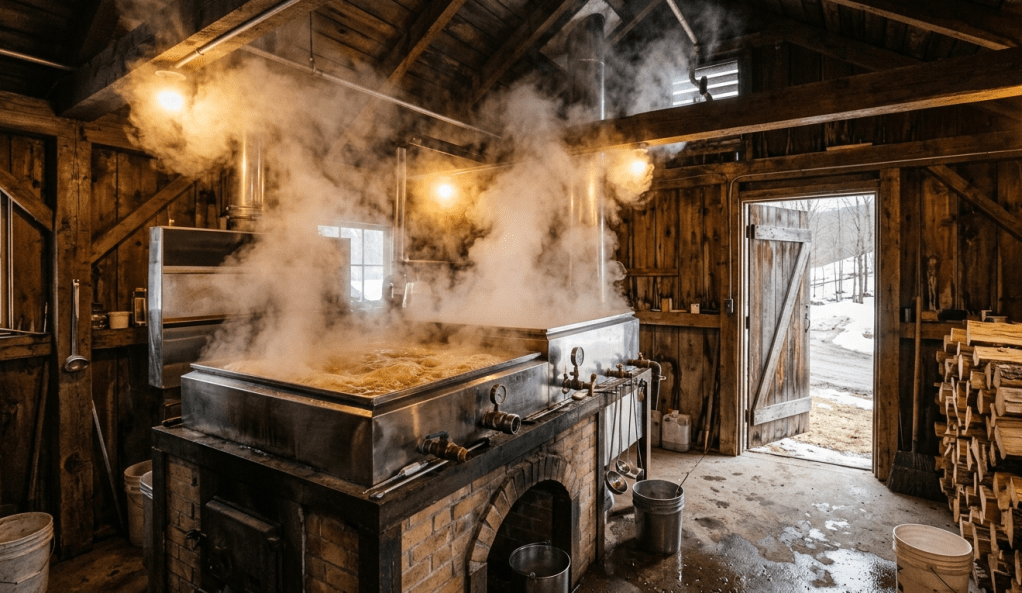
What they share is the steam venting from the cupola or the peak of the roof, the smell, and the light glowing from inside. There is usually a stack of cordwood nearby, sometimes enormous, that tells you how many weeks this operation has been running. Sugar making takes a tremendous amount of wood to boil down sap, roughly 40 gallons of sap for every gallon of finished syrup, and the woodpile reflects that math.
Inside the Sugarhouse: What You Will See, Smell, and Hear
The Evaporator and the Boiling Process
Walk through the door and the warmth catches you immediately. After the cold outside, the air inside feels almost tropical. The evaporator sits at the center of the room, a long, stainless steel pan set over a firebox, divided into channels that move sap from one end to the other as it concentrates and thickens.
The sap that goes in looks like water with a slight haze. By the time it reaches the draw-off point at the far end, it has become maple syrup, amber and sweet and thick enough to coat a spoon. The sugar maker watches the temperature and the density closely, drawing off syrup when it hits the right point and filtering it before it goes into jugs or cans.
The sound of a working evaporator is its own thing. There is a low roar from the fire below, a bubbling from the pan above, and the occasional clank and hiss of adjustments being made. It is a working sound. It sounds like something is being made.
The People Who Make It Happen
Sugar makers are a specific kind of Vermont character. They have usually been doing this for a long time, and many of them learned it from someone who learned it from someone else. Ask a question and you will get a real answer. Ask a follow-up question and you may end up staying an hour longer than you planned.
There is a quiet pride that runs through these operations. Nobody is performing for you. They are doing their work, and you are welcome to watch, and if you are curious and respectful, most sugar makers genuinely enjoy the company during a long boil. The conversation tends to be easy. Vermont hospitality does not announce itself. It just shows up.
Sugar on Snow: The Treat You Have to Try
If you visit a sugarhouse during an open house or at a farm that welcomes visitors during the season, there is a good chance you will be offered sugar on snow. It is exactly what it sounds like: hot maple syrup poured in a thin stream over a trough or pan of clean packed snow, where it cools almost instantly into a soft, chewy ribbon of maple taffy.
You pick it up on a wooden stick or a fork, roll it slightly, and eat it. It is sweet in a way that feels earned rather than manufactured. The cold snow and the hot syrup meet somewhere in the middle, and the result is something you cannot replicate at home with ice from your freezer. The texture is different. The flavor is different. The context is different.
Tradition pairs sugar on snow with a dill pickle and a plain cake donut. If you have not tried it, do not skip it. The pickle cuts the sweetness and resets your palate. The donut soaks up the syrup that drips. It is a combination that sounds strange and tastes exactly right.
What Mud Season Has to Do With All of This
Sugaring season and mud season are the same season. They overlap almost completely, and that is not a coincidence. The same thaw that softens the ground and turns dirt roads into a test of patience is the same thaw that gets the sap running. Vermont’s fifth season is not just about inconvenience. It is about transition.
Driving to a sugarhouse in March usually means navigating some soft shoulders, a few muddy pull-offs, and roads that have seen better days since October. Slow down, stay on the harder surface where you can, and give yourself extra time. The mud is part of the experience, not a problem to be solved.
There is something honest about mud season that Vermonters tend to appreciate even while complaining about it. The ground is thawing. The trees are waking up. The landscape is in the middle of becoming something new, and it is not trying to look good while it does it. The sugarhouse feels like the right place to be during all of that.
How to Visit a Vermont Sugarhouse This Season
What to Look for When Choosing a Sugarhouse to Visit
Not every sugarhouse is open to visitors, and not every operation runs on the same schedule. The best way to find one is to check local listings, the Vermont Maple Sugar Makers Association website, or simply follow a small farm on social media. Many producers post when they are boiling, which is your signal that the door is open.
Vermont Maple Open Farm Week typically happens in late March and into April, when farms across the state formally welcome visitors for tours, tastings, and demonstrations. It is a great entry point if you are not sure where to start. That said, showing up at a small sugarhouse on a Tuesday afternoon when the steam is rising from the stack is often its own kind of perfect.
What to Bring and How to Dress
- Mud boots or waterproof footwear. This is not optional. The parking area and surrounding ground will be soft at best.
- Warm layers. The sugarhouse itself is warm, but walking to it and standing outside is still March in Vermont.
- Cash or card for syrup. Most farms sell directly and some smaller operations prefer cash.
- An appetite. Sugar on snow is filling, but in the best way.
What to Buy Before You Leave
Vermont syrup comes in four grades, all of which are pure maple syrup. The grades refer to color and flavor intensity rather than quality. Golden is delicate and mild. Amber is the classic Vermont flavor that most people picture. Dark is robust and works well for cooking and baking. Very Dark is the boldest and is often used in savory applications.
Beyond syrup, most sugarhouses sell a few other products worth knowing about.
- Maple cream is a spreadable, smooth maple product with an almost frosting-like texture. It belongs on a biscuit.
- Maple candy is made by cooling and stirring syrup until it sets. It dissolves slowly and tastes exactly like the best part of the season.
- Maple butter (also called maple spread) is similar to maple cream and excellent on toast or stirred into oatmeal.
Buy more than you think you need. You will use it, and you will wish you had grabbed an extra jar before the drive home.
Why This Is One of Vermont’s Best Kept Seasonal Secrets
Most people who plan a Vermont trip think about fall foliage or ski season. Those are both real and worth experiencing. But sugaring season occupies a different category. It is quieter, more intimate, and rooted in something that has been happening here for centuries. The sugarhouse is not a performance. It is a place where work is being done, and visitors are welcomed into that work in a way that feels genuinely special.
There are no lift lines. There are no leaf-peeper traffic jams. There is just a warm building in the middle of a muddy March landscape, steam rising into cold air, and someone inside who has been awake since before dawn doing something they know how to do very well. That is Vermont. And if you time it right, that is yours.
The season does not last long. A few good weeks, maybe six if the weather cooperates, and then it is over until next year. That is part of what makes it worth showing up for.
Shop Green Mountain Peaks on Etsy
Bring a little piece of Vermont into your home with our curated collection of gifts, apparel, and seasonal favorites. From cozy hoodies and crewnecks to Vermont-themed gift boxes and cookbooks, each item is designed to celebrate the Green Mountain spirit.
- Vermont-inspired designs and gift sets
- Printed and packaged with care
- Ships directly to your door
Discover gifts, apparel, and Vermont treasures made to share and enjoy year-round.

Leave a comment