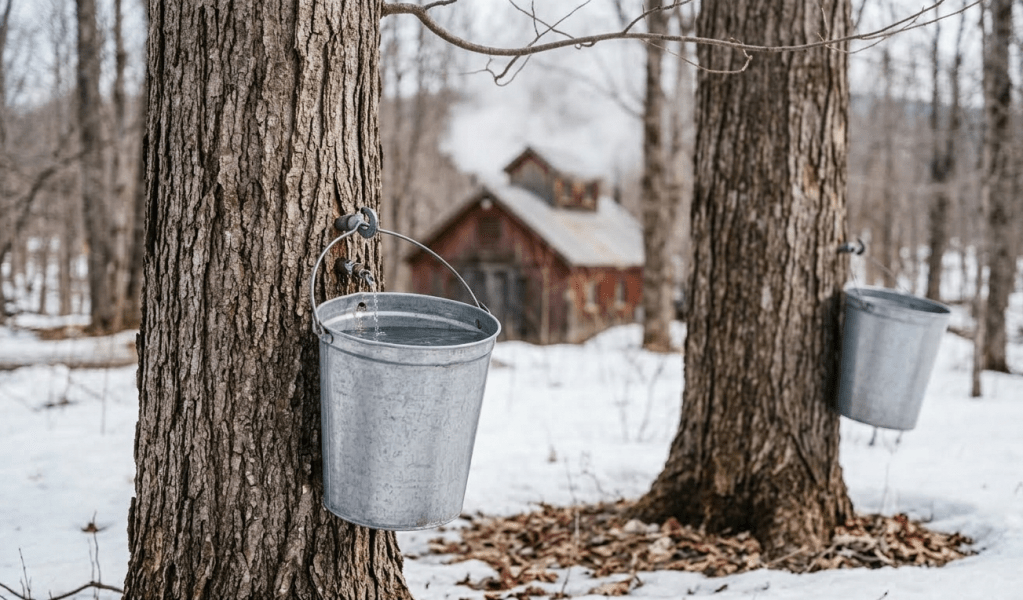
Every spring, Vermont does something the rest of the country watches from a distance. The snow is still deep in the woods. The mud is doing its worst to every dirt road in the state. And somewhere on a hillside, a sugar maker has been awake since before sunrise, feeding a fire and watching a pan of pale sap slowly transform into something amber, sweet, and unmistakably Vermont.
Maple season is one of those things that sounds simple until you start paying attention to it. Then you realize it is actually a precise, weather-dependent, biologically fascinating process that has been refined over centuries right here in the Green Mountain State. Whether you are visiting Vermont for the first time or you have lived through a few dozen sugaring seasons yourself, here is how it actually works.
Why Vermont Is the Center of the Maple World
Vermont produces more maple syrup than any other state in the country, and it is not particularly close. The combination of climate, tree density, and generational knowledge makes the state uniquely suited for it. Sugar maples thrive in the northeast, and Vermont’s terrain and temperature swings create near-ideal conditions for sap production season after season.
The practice of tapping maple trees for sap goes back long before European settlement. Indigenous peoples across the northeast had developed methods for collecting and concentrating maple sap centuries before colonists arrived and adapted those techniques into what eventually became the commercial industry Vermont is known for today. What you see at a Vermont sugarhouse in March is the current chapter of a very long story.
It All Starts With the Trees
Sugar Maples and Why They Matter
Not all maple trees are created equal when it comes to syrup. The sugar maple (Acer saccharum) produces sap with a significantly higher sugar content than other maple species, which means less boiling time and a better-tasting finished product. Vermont’s forests are full of them, and that is a large part of why the industry is centered here.
A tree needs to reach a certain size before it can be tapped responsibly. Most sugar makers wait until a maple is at least 10 to 12 inches in diameter at chest height, which typically takes 40 or more years of growth. A single healthy tree can be tapped for generations if the work is done carefully. Many of the trees being tapped in Vermont today were already mature when the great-grandparents of the current sugar makers were learning the trade.
How the Sap Actually Forms
During the winter, sugar maple trees store starch in their wood and root systems. As temperatures begin to rise in late winter, that starch converts into sugar and dissolves into water within the tree’s cells. The result is sap, a liquid that is roughly 98 percent water and about 2 percent sugar (though this varies by tree and by the conditions of the season).
What moves the sap is pressure. When temperatures drop below freezing at night and then rise above freezing during the day, it creates alternating positive and negative pressure inside the tree. That pressure differential is what pushes sap toward any opening in the bark, including a tap. No freeze and thaw cycle, no sap flow. It is that direct.
The Freeze and Thaw Cycle: Vermont’s Most Important Weather Pattern
Ask any Vermont sugar maker what they are watching during the season and the answer is always the forecast. Specifically, they are looking for nights that dip below 32 degrees Fahrenheit and days that climb into the low 40s. That range, cold nights and cool-to-mild days, is the sweet spot for a good sap run.
If the overnight temperature stays above freezing, the pressure cycle does not complete and sap movement slows or stops. If the days warm up too much and stay warm, the season heads toward its end faster than anyone wants. A late winter cold snap after a warm stretch can sometimes restart things briefly, but the window is always narrower than it looks on the calendar.
This is why sugar makers are some of the most weather-literate people in Vermont. They are not checking the forecast for convenience. They are making decisions about when to fire up the evaporator, when to pull a crew together, and when the season is telling them something important.
When Does Vermont Maple Season Start and End?
Typical Timing by Region
Vermont maple season does not start on the same date everywhere. It moves from south to north as temperatures warm across the state. Operations in southern Vermont and the lower valleys often see their first runs in late February. The Northeast Kingdom, up near the Canadian border, may not hit its stride until mid-March or later, and in a good year runs well into April.
Across the whole state, a strong season might span six to eight weeks from the first trickle in the south to the last boil in the north. A warm or erratic winter can compress that to two or three weeks. There is no way to know in advance exactly what you are going to get, and that unpredictability is something every producer has made peace with.
What Ends the Season
The season ends when the trees say it does. The most reliable signal is bud break, the moment the sugar maple begins pushing new growth from its buds. Once that happens, the sap chemistry changes. It develops a bitter, off flavor that sugar makers describe bluntly and that no amount of boiling improves. The syrup made just before bud break tends to be darker and more robust, which is part of why the Very Dark grade exists.
A sustained warm stretch with no overnight freeze will also end a season before bud break. The pressure cycle stops, the sap slows, and the evaporator goes cold. Experienced producers can often taste the shift coming in the last runs of the season. They know when the trees are done.
How Sap Becomes Syrup: The Boiling Process Explained
Collection Methods: Buckets vs. Tubing
There are two main ways to collect sap from a tapped maple tree. The traditional method uses metal buckets hung directly below the tap. You have seen them on the sides of trees along Vermont back roads in late winter, and they are exactly what they look like. Smaller farms and hobby operations still use buckets widely, and there is something genuinely satisfying about walking a sugarbush with a collection tank and gathering runs by hand.
Larger commercial operations more commonly use a system of plastic tubing that runs from tree to tree and eventually down the hillside to a collection tank at the sugarhouse. Many of these systems use vacuum pumps to increase sap yield per tree. Both methods are legitimate and both are still common across Vermont. The tubing systems are efficient; the buckets are beautiful.
The Evaporator and the Boil-Down
Once sap reaches the sugarhouse, it goes into the evaporator. This is the long, divided pan set over a firebox that is the heart of every sugarhouse operation. Sap enters at one end, thin and pale as water with a faint sweetness. It moves through a series of channels as it concentrates, and by the time it reaches the draw-off point at the far end, it has become maple syrup.
The ratio that every Vermont sugar maker quotes from memory is roughly 40 gallons of raw sap to produce one gallon of finished syrup. In a low-sugar year, that number climbs closer to 50 gallons or more. This is why boiling takes so long and why a working evaporator runs for hours at a stretch. The fire has to stay hot, the pan has to stay at the right level, and the sugar maker has to monitor the temperature at the draw-off point closely, targeting around 219 degrees Fahrenheit at sea level (adjusted slightly for elevation).
Many Vermont sugarhouses still use wood-fired evaporators. The wood contributes to the atmosphere of the place, the smell, the sound, the visual of a fire roaring beneath a pan of boiling sap, and some producers believe it contributes subtly to the flavor profile as well. Oil and propane-fired systems are also used, particularly in larger operations where consistency and efficiency matter most.
Understanding Vermont Maple Syrup Grades
Since 2015, Vermont has used the same grading system as the USDA, which simplified things considerably. There are now four grades, and all of them are Grade A, meaning all four are pure, table-quality maple syrup. The grade describes color and flavor intensity, not quality ranking.
- Grade A Golden, Delicate Taste: Light in color, mild and subtle flavor. Often comes from the earliest runs of the season when sugar content is high and the sap is very fresh.
- Grade A Amber, Rich Taste: The classic Vermont maple flavor most people picture. A good all-purpose syrup for table use, baking, and cooking.
- Grade A Dark, Robust Taste: Deeper color and more intense maple flavor. Excellent for cooking, glazing, and anywhere you want the maple to stand up to other strong flavors.
- Grade A Very Dark, Strong Taste: The boldest grade, typically produced near the end of the season. Used heavily in commercial food production and by home cooks who want maximum maple impact in savory dishes.
When you buy syrup directly from a Vermont producer, you will often have the chance to taste before you buy. Take them up on it. The difference between grades is real and noticeable, and what you prefer on your pancakes may be completely different from what you want in a marinade.
What a Good Season Looks Like (And What Can Go Wrong)
A strong maple season in Vermont means multiple distinct sap runs spread across several weeks, with reliable freeze and thaw patterns that give producers time to collect, boil, and prepare between runs. In a year like that, sugarhouses run nearly continuously for stretches, and the yield per tap is high. Those are the years producers talk about for a long time afterward.
Climate change is making the season harder to predict and, in some years, harder to execute. Warmer winters mean fewer overnight freezes, inconsistent pressure cycles, and seasons that start earlier and end sooner than historical averages. Some producers in southern Vermont have seen their window compress noticeably over the past two decades. The industry is adapting, but the underlying biology of the trees cannot be rushed or rescheduled.
Sugar makers also talk about vintage years the way winemakers do. The 2023 season in Vermont was notably strong across much of the state. Other years are remembered for specific challenges, a brutal cold snap in March, a warm week that ended things too fast, a late freeze that gave everyone one unexpected last run. Every season has its own character, and every jug of syrup carries a little of that.
How to Experience Maple Season If You’re Visiting Vermont
Sugarhouse Visits and Open Farm Week
Vermont Maple Open Farm Week typically runs during the last week of March and into early April, with farms across the state formally opening their doors for tours, tastings, and demonstrations. It is organized, well-attended, and a genuinely good way to see multiple operations in a single trip. The Vermont Maple Sugar Makers Association maintains a current list of participating farms each year.
Outside of Open Farm Week, the best signal that a sugarhouse is welcoming visitors is visible steam from the stack. If smoke is rising and cars are in the lot, it is usually fine to walk up and knock. Most sugar makers doing an active boil are happy to have curious people come through. Just be respectful of the work happening around you and dress for the conditions.
What to Buy and Where
Buying directly from the farm gets you the freshest product, the full range of grades, and often a conversation about the season that no grocery store shelf can offer. Farmers markets and food co-ops around Vermont also carry local syrup year-round from multiple producers.
Beyond syrup, most sugarhouses sell a few products worth knowing:
- Maple cream (also called maple butter or maple spread): A smooth, spreadable product made by cooling and stirring syrup until it reaches a creamy consistency. No dairy involved. Extraordinary on a biscuit.
- Maple candy: Made by heating syrup and pouring it into molds as it cools. Dissolves slowly and tastes like the concentrated heart of the season.
- Maple sugar: Granulated maple, used in baking and as a substitute for cane sugar with a distinct flavor advantage.
Buy more than you think you will use. Everyone who has ever left a Vermont sugarhouse with one small jug has regretted it by July.
Maple season is brief, specific, and rooted in a combination of biology, weather, and deep Vermont know-how that took generations to develop. Coming here during those few weeks in March and April and seeing it in person is one of the better decisions you can make about how to spend a spring day in the Green Mountains.
Shop Green Mountain Peaks on Etsy
Bring a little piece of Vermont into your home with our curated collection of gifts, apparel, and seasonal favorites. From cozy hoodies and crewnecks to Vermont-themed gift boxes and cookbooks, each item is designed to celebrate the Green Mountain spirit.
- Vermont-inspired designs and gift sets
- Printed and packaged with care
- Ships directly to your door
Discover gifts, apparel, and Vermont treasures made to share and enjoy year-round.

Leave a comment