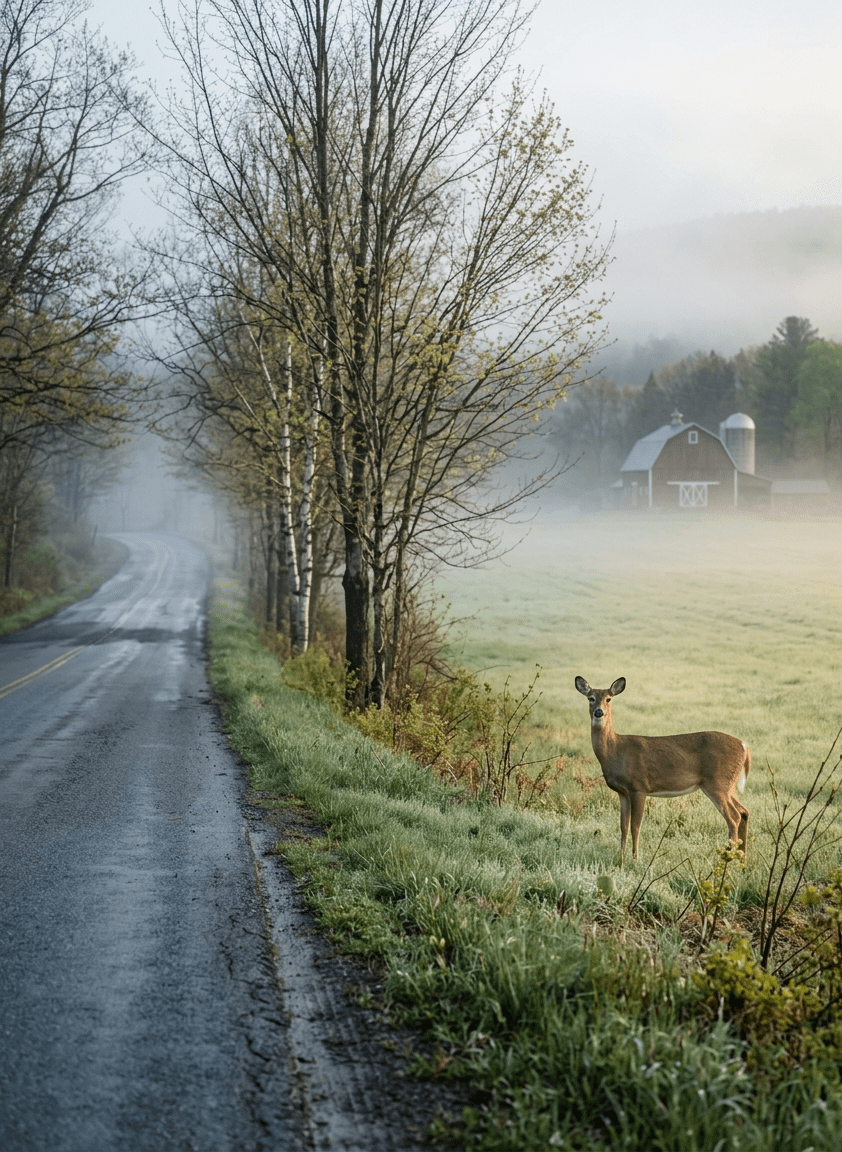
There is a specific kind of morning in late May in northern Vermont where the light is still low, the fields are wet with dew, and something is standing at the edge of the tree line that was not there a second ago. A white-tailed deer, a wild turkey, sometimes a fox trotting along the fence row with somewhere important to be. If you have never driven a back road in Vermont during spring, this is the version of the state that people who live here know best.
Spring is not a subtle season here. After a long winter and the slog of mud season, the green-up happens fast and the wildlife moves with it. From late April through early June, the roadsides and fields of northern Vermont turn into some of the most consistently rewarding places in New England to see wild animals going about their lives.
You do not need a guided tour or a spotting scope. You mostly just need to slow down and pay attention.
Why Spring Is the Best Season for Vermont Wildlife Watching
The short answer is that everything is moving at once. Animals that spent the winter deep in the woods or hunkered in low spots are coming out to feed on new growth, find mates, and raise young. The vegetation has not fully leafed out yet, which means sightlines are longer than they will be in July. And the light in May, especially in the early morning and the hour before sunset, is extraordinary.
This is different from fall foliage season, which draws people to Vermont for the color. Spring wildlife watching is quieter, less crowded, and in some ways more rewarding because you are watching the state wake up rather than wind down. The roadsides that will be packed with leaf-peepers in October are yours in May, and the animals have not yet retreated into the full cover of summer.
Plan your drives for dawn and dusk if you can. That is when deer, turkeys, foxes, and black bears are most likely to be visible in open areas. Overcast days in May are often surprisingly active, especially around wetlands where herons and shorebirds are feeding in the shallow margins.
What You Are Likely to See on a Drive Through Northern Vermont
The honest answer is that it depends on where you go and how slowly you drive, but here is what shows up consistently.
White-Tailed Deer
Deer are the most reliable spring sighting in Vermont. They move out of winter cover as the grass comes in, and you will see them in fields and meadows in the early morning and evening hours. A doe with a fawn is possible by late May. Drive any stretch of Route 15 between Morrisville and Johnson at dusk and you are very likely to see deer in the fields along the Lamoille River.
Wild Turkeys
Turkeys are having a moment in Vermont. The population has grown considerably over the past two decades and you will see them year-round, but spring is when they are most visible and most interesting. Toms strut and fan their tails in open meadows during mating season, and flocks of hens move through agricultural fields and roadsides with a kind of unhurried confidence. If you have never seen a full-display tom turkey up close, it is genuinely impressive.
Black Bears
Bears emerge from their dens in spring hungry and looking for food. They are most often spotted in the early morning near berry-producing shrubs, agricultural areas, and forest edges. Sightings are not rare in northern Vermont, but they require some patience. The Northeast Kingdom and the hill towns east of Morrisville are productive areas. A bear sighting is one of those Vermont experiences that feels significant the first time it happens, especially if you are used to wildlife meaning squirrels and pigeons.
Red Foxes
Fox pups are born in late winter, and by May the adults are very active hunting rodents in fields and meadows to feed them. You will sometimes see a fox trotting a fence line or sitting in tall grass watching for movement. Old farm properties with a mix of open field and brushy edge habitat are reliable fox territory throughout northern Vermont.
The Best Routes for Wildlife Watching in Northern Vermont
You do not have to go far from the main roads to find good wildlife habitat, but the back roads are where the real encounters happen. Here are the stretches worth building a slow drive around.
- Route 15 through the Lamoille Valley (Morrisville to Hyde Park to Johnson). This corridor follows the Lamoille River through wide agricultural bottomland. Deer, turkeys, and herons are common. Drive it at dusk with your windows down.
- Route 100 north from Stowe toward Lowell and Jay. This is one of the most scenic spring drives in the state. The road passes through remote hill country with beaver ponds, wetland edges, and stretches where you might not see another car for twenty minutes. Bear sightings happen here.
- The roads around Missisquoi National Wildlife Refuge near Swanton. This is one of the best birding spots in Vermont and a reliable area for waterfowl, osprey, and great blue herons during spring migration and nesting season.
- Route 108 through Smugglers’ Notch (once it reopens, typically in late May). The notch itself is dramatic, but the farmland on the Jeffersonville side in the morning is reliably good for deer and turkeys.
- Back roads around Lake Carmi State Park in Franklin. Less visited than many Vermont destinations, this is excellent habitat for wading birds and waterfowl, and the surrounding farmland is good for mammals at dawn.
Birds Worth Watching For (Even If You Are Not a Birder)
You do not have to be a birder to appreciate what is happening in Vermont’s fields and wetlands in May. A few species are distinctive enough that they tend to catch people off guard, in the best way.
The bobolink is worth mentioning first because its call is unlike anything else. It sounds mechanical and bubbly at the same time, like something a science fiction prop designer would invent. Bobolinks nest in Vermont hayfields and you will hear them before you see them, hovering and singing over tall grass from late May onward. They are grassland birds that have declined in many places as land use has changed, which makes hearing them in a Vermont field feel genuinely lucky.
Great blue herons are reliable near any slow-moving water. They stand completely still in the shallows and then move with a speed that seems impossible for a bird that large. Osprey have returned to Vermont in strong numbers and you will often see them hovering over rivers and ponds before diving for fish. The Lamoille River corridor and Lake Carmi are both good spots.
Red-winged blackbirds are worth mentioning not because they are rare but because their call is the sound of a Vermont spring. The moment the males start singing from cattails and fence posts, you know the season has turned for real.
The Moose Question
Everyone asks about moose, and the honest answer is: they are real, they are worth looking for, and they are not guaranteed even in the best habitat. Vermont’s moose population has faced pressure from a warming climate and the winter tick, which has reduced numbers in some areas. But moose are still present, especially in the Northeast Kingdom and in the remote hill country of northern Lamoille County.
Spring is actually a genuinely good window for moose sightings for one specific reason: they are drawn to roadsides to lick mineral salts that accumulate from road treatment during winter. Wetland edges, willow thickets, and shallow pond margins near the Canadian border region are your best options. Dawn is the most reliable time.
If you do see a moose near a road, stay in your vehicle. They are enormous (a cow moose can weigh 700 pounds), and they are not as predictable as deer. Give them time and space and they will usually move on their own.
How to Watch Without Getting in the Way
The best wildlife watching in Vermont happens when you are quiet and still. Pulling slowly to the side of a back road and turning off your engine will get you farther than driving up a farm lane or stepping out into a field. Animals key on movement and noise, and a parked car is far less threatening to them than a person standing in the open.
Resist the instinct to get closer. A good photo from a respectful distance is better than a stressed animal that has to flee. This is especially true for bears with cubs and birds on nests, both of which are common in late spring.
Five minutes of patience in the right spot will often produce more than an hour of driving. Find a wetland edge, a field margin, or a stretch of river valley, stop, and just watch what is already there.
What This Has to Do With Living Here
One of the things people who move to northern Vermont mention most often is that the wildlife stops being scenery and starts being neighbors. A fox den under the shed. Turkeys crossing the driveway in November. A bear in the compost pile. A moose standing in the back field at six in the morning.
This is part of what rural Vermont actually means. The wildlife corridors and the habitat that supports these animals are the same landscape that shapes where towns are, where farms sit, and where people build houses. It is not separate from Vermont life. It is threaded through it.
If you are thinking about what it would be like to live here year-round, a slow spring drive north is one of the better ways to start understanding what that actually looks like on an ordinary morning.
You do not need a destination. Just a full tank, a slow pace, and your windows down.
Shop Green Mountain Peaks on Etsy
Bring a little piece of Vermont into your home with our curated collection of gifts, apparel, and seasonal favorites. From cozy hoodies and crewnecks to Vermont-themed gift boxes and cookbooks, each item is designed to celebrate the Green Mountain spirit.
- Vermont-inspired designs and gift sets
- Printed and packaged with care
- Ships directly to your door
Discover gifts, apparel, and Vermont treasures made to share and enjoy year-round.

Leave a comment