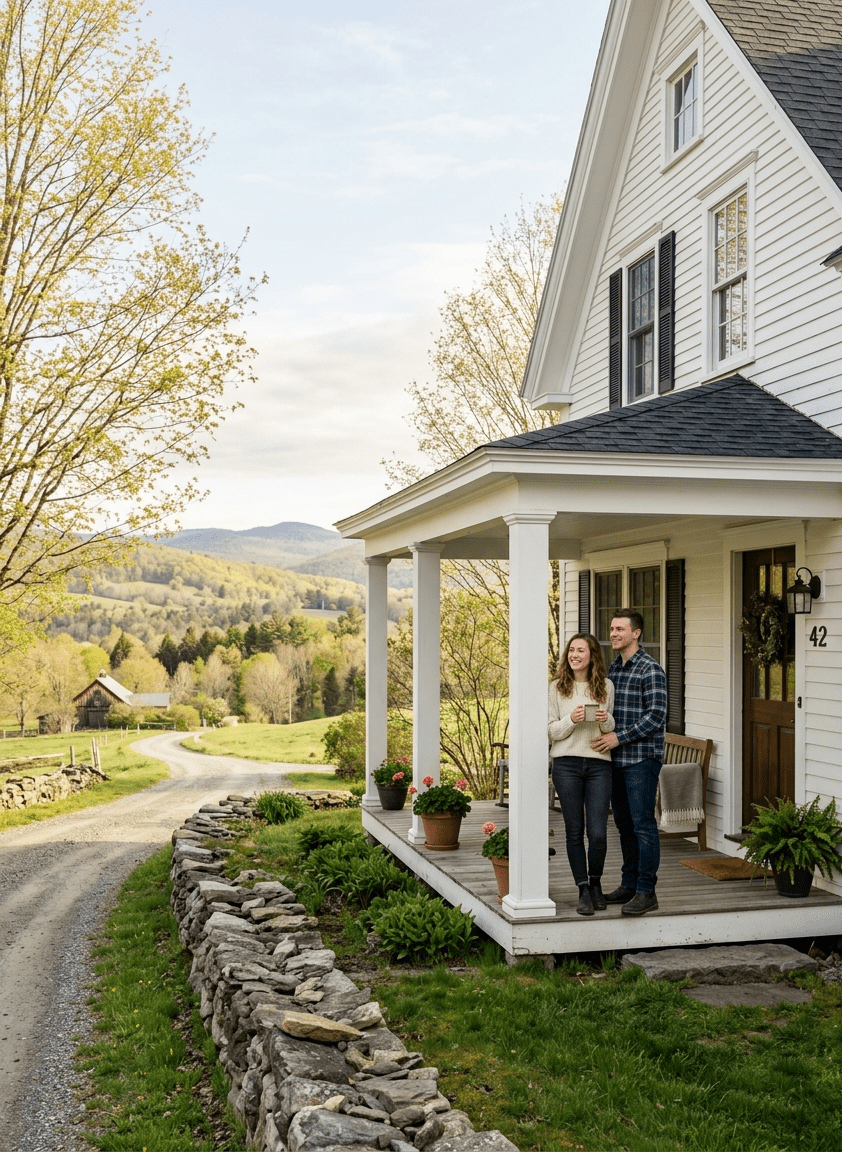
Buying your first home anywhere is a big deal. Buying your first home in Vermont comes with its own particular set of things to understand, most of which nobody outside the state will tell you about. The market moves fast in the places people most want to live, the housing stock is old and quirky in the best and occasionally costly ways, and the things that make Vermont homes special are sometimes the same things that make them complicated.
This guide is for people who are serious about buying in Vermont and want a realistic picture of what that process actually looks like, not a checklist built for a generic suburban market. Whether you are already living here or making plans to move, here is what you need to know.
Get Pre-Approved Before You Do Anything Else
This is not just standard advice. In Vermont’s lower-inventory markets, particularly in Chittenden County and the towns surrounding Stowe, Morrisville, and Burlington, well-priced homes in good condition regularly receive multiple offers within days of listing. Showing up without a pre-approval letter means you are not a real buyer yet, and sellers know it.
Pre-approval is different from pre-qualification. Pre-qualification is a quick estimate based on self-reported information. Pre-approval involves a lender actually verifying your income, assets, credit, and employment, and it carries real weight when you make an offer. Get the pre-approval before you fall in love with a house.
Consider a Local Vermont Lender
National lenders can work, but local Vermont lenders often have advantages that matter during the buying process. They know the market, they understand Vermont property types including rural parcels with wells and septic systems, and they can sometimes move faster at critical moments. A listing agent who has worked with a particular local lender before will have more confidence in your offer as a result.
The Vermont Housing Finance Agency (VHFA) is worth knowing about if you are a first-time buyer or have not owned a home in the past three years. VHFA offers the Move program, which provides below-market mortgage rates to qualifying buyers, and the Move MCC, a mortgage credit certificate that lets you claim a portion of your annual mortgage interest as a federal tax credit. Income and purchase price limits apply, but many first-time buyers in Vermont fall within them. A VHFA-participating lender can walk you through eligibility in about fifteen minutes.
Understanding the Vermont Housing Market
The defining feature of most Vermont real estate markets right now is inventory. There are simply not many homes for sale relative to the number of buyers looking, and that dynamic has held for several years. In practical terms, it means that when a good home hits the market at a fair price, it tends to move quickly.
Price ranges vary a lot by region. Chittenden County, which includes Burlington, South Burlington, and Williston, is the most expensive market in the state. Lamoille County towns like Morrisville, Hyde Park, and Johnson tend to offer more accessible price points with shorter commutes to Stowe and Burlington than people assume. The Northeast Kingdom, covering Orleans, Essex, and Caledonia counties, has the most affordable prices but also the fewest amenities and the longest distances from employment centers.
What First-Time Buyers Often Get Wrong About Vermont Home Prices
The sticker price is only part of the picture. A Vermont home listed at $275,000 might look like a deal, and it might be. But the cost of heating an old farmhouse through a Vermont winter, replacing a failing well pump, or connecting to high-speed internet in a rural town can change the math significantly.
Heating costs deserve particular attention. Vermont winters are real, and homes heated with oil or propane can cost $3,000 to $5,000 or more per season depending on the size of the house and how well insulated it is. Heat pumps have become a much more common and cost-effective option in recent years, but not every home is set up for them. Understanding the heating situation before you make an offer is important.
Property taxes also vary by town. Vermont’s education funding system means that property tax rates are not uniform across the state, and the tax bill on a comparable property can differ noticeably from one town to the next. Ask your agent about current rates in any town you are seriously considering.
The Vermont Home Inspection Is Not Optional
I know buyers in competitive markets sometimes feel pressure to waive inspection contingencies to make their offer more attractive. In Vermont, that is a risky move worth thinking very carefully about. The housing stock here is old. Many homes were built well before modern building codes, and even a well-maintained older Vermont farmhouse can have things that a thorough inspection will surface.
A standard home inspection in Vermont should include the structure, roof, foundation, electrical, plumbing, and HVAC. But for most Vermont properties, you also want:
- A well flow test and water quality test. You want to know the well produces adequate water and that the water is safe to drink. Coliform bacteria and arsenic are the most common concerns in Vermont well water. These tests are relatively inexpensive and worth every penny.
- A septic system inspection. Many Vermont homes have older septic systems, and a failing system can be a very expensive fix. Ask when the system was last pumped and inspected, and hire someone to evaluate it properly before closing.
- A review of the heating system. Old oil boilers and furnaces can be functional but nearing the end of their lifespan. Know what you are working with before you commit.
A good inspector in Vermont will be familiar with the quirks of older New England construction. Ask for recommendations from your agent or people who have recently bought in the area you are targeting.
Vermont-Specific Things Every First-Time Buyer Should Know
Vermont has a few property-related considerations that do not come up in most first-time buyer guides written for other markets.
- Broadband access. Rural Vermont still has significant gaps in high-speed internet coverage. If you work remotely or plan to, verify actual broadband availability at a specific address before you make an offer. “Available in the area” is not the same as “available at this house.”
- Private road maintenance agreements. Many Vermont properties are accessed by private roads shared with neighbors. Make sure there is a written maintenance agreement in place and understand what you are responsible for. Plowing, grading, and gravel replacement add up.
- Act 250. Vermont’s land use and development control law applies to certain types of development and land subdivision. It does not affect most standard home purchases, but if you are buying a property with development potential or a larger land parcel, it is worth understanding what Act 250 review would involve.
- Current use enrollment. Properties with significant acreage may be enrolled in Vermont’s Use Value Appraisal program (commonly called current use), which reduces the assessed value of farm and forest land for tax purposes. Enrollment has conditions attached, so understand what you are taking on if the property is enrolled.
Vermont Programs That Can Help First-Time Buyers
Beyond the VHFA programs already mentioned, there are a few other resources worth knowing about.
USDA Rural Development loans offer zero-down-payment financing for eligible buyers in qualifying rural areas. A surprising number of Vermont properties and towns fall within USDA eligible zones, including many in Lamoille, Orleans, and Essex counties. Income limits apply, but for first-time buyers, this is a program worth checking.
If you are relocating from out of state and working remotely, Vermont’s Worker Relocation Incentive Program through ThinkVermont.com offers up to $7,500 to eligible remote workers who move to Vermont. It is not a mortgage program, but $7,500 toward moving costs or closing costs is real money at a stressful time.
A good Vermont lender will know how to layer these programs together and tell you honestly which ones you qualify for. Ask directly and ask early in the process.
Working With a Vermont Real Estate Agent
Vermont’s towns and markets are genuinely different from each other in ways that do not show up in a Zillow search. A buyer’s agent who knows the difference between the Morrisville and Hyde Park markets, understands which roads flood in mud season, and has relationships with local inspectors and lenders will help you avoid costly mistakes and move confidently when the right home comes up.
One important change to understand before you start: as of August 2024, buyer’s agent compensation is no longer automatically offered by sellers through the MLS. Before you tour any homes, you will sign a written buyer representation agreement with your agent that clearly states how their compensation works and what the rate is. In some transactions, sellers still offer to cover the buyer’s agent fee as part of negotiations, but it is not guaranteed. Talk through the compensation structure openly with any agent you are considering before you commit.
I work with buyers in Lamoille County and surrounding areas including Stowe, Morrisville, Hyde Park, Johnson, Cambridge, and Burlington. If you are looking in northern Vermont and want to talk through what the buying process looks like right now, I am happy to help.
What Happens After You Find a Home You Love
The offer process in Vermont follows a fairly standard New England purchase and sale agreement format. Earnest money deposits are typically one to three percent of the purchase price. Your agent will help you determine what offer price and terms make sense given current market conditions and the specific property.
From accepted offer to closing typically runs four to six weeks in Vermont, though it can be faster with a motivated seller and an efficient lender. That window covers inspections, financing finalization, title search, and any negotiations that come up after inspection.
Budget for closing costs in the range of two to four percent of the purchase price. This covers lender fees, title insurance, transfer taxes, recording fees, and prepaid items like homeowners insurance and property tax escrow. Your lender is required to give you a Loan Estimate early in the process, which will lay out the expected costs clearly.
Vermont’s property transfer tax is paid by the buyer at closing. For a primary residence, the rate is 0.5% on the first $200,000 of the purchase price, and 1.47% (which includes the Clean Water Surcharge) on any value above that. On a $350,000 primary residence, that works out to roughly $3,245 at closing. Your Loan Estimate will reflect the exact figure for the home you are purchasing.
Buying your first home in Vermont is genuinely worth doing right. The state rewards the people who put down roots here, and a home in northern Vermont is not just an asset. It is a front-row seat to one of the most quietly extraordinary places in New England.
Shop Green Mountain Peaks on Etsy
Bring a little piece of Vermont into your home with our curated collection of gifts, apparel, and seasonal favorites. From cozy hoodies and crewnecks to Vermont-themed gift boxes and cookbooks, each item is designed to celebrate the Green Mountain spirit.
- Vermont-inspired designs and gift sets
- Printed and packaged with care
- Ships directly to your door
Discover gifts, apparel, and Vermont treasures made to share and enjoy year-round.

Leave a comment