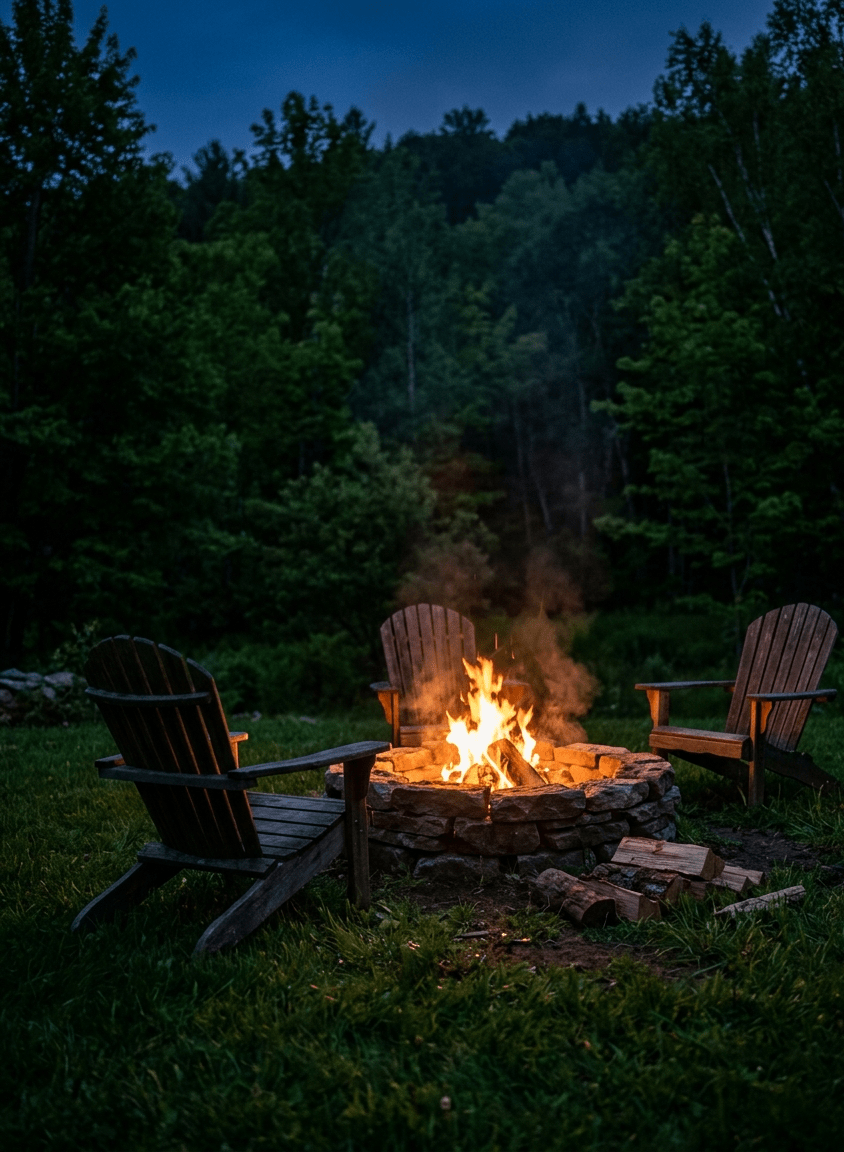
There is a moment every spring in Vermont when you know the season has actually turned. It is not the calendar date, and it is not the first warm afternoon. It is the evening you finally drag the chairs back out to the fire pit, stack some wood, and light it without feeling like you are rushing the season.
That moment usually comes somewhere in May, after mud season has done its worst and the ground has firmed up enough to stand on without losing a boot. The air still has a bite to it after the sun goes down. The peepers are going full volume in whatever wet patch is nearest to your yard. And the fire feels like exactly the right response to all of it.
This is one of my favorite Vermont rituals, and it does not get talked about nearly as much as foliage or maple season. But if you live here, or if you have spent a real stretch of time here in the warmer months, you know exactly what I mean.
When the Fire Pit Comes Back Out
Mud season in Vermont is real and it is humbling. From late March through most of April, the ground is saturated, the dirt roads are soft, and everything feels a little suspended. You are not quite in winter anymore but you are not in spring either. You are just waiting.
When it finally breaks, it breaks fast. The grass starts to green up almost overnight. People are outside again. And the first fire of the season feels less like a choice and more like a necessity, a way of marking the shift and celebrating the fact that the long part is over.
There is something about that first fire in May that tastes better than any fire in July. Maybe it is the relief. Maybe it is the contrast with what just came before. Either way, it sets the tone for the whole season ahead.
The People Who Appear
Fire pits have a gravity to them that I cannot fully explain. Light one in your backyard and people materialize. Not because you planned anything or sent a message, just because there is a fire and that is enough of a reason.
Neighbors you have waved to all winter end up pulling up a chair. Someone brings something to drink. Someone else shows up with food. By the time it is fully dark you are deep into a conversation that started nowhere in particular and went somewhere good, and nobody is checking their phone because there is no reason to.
Vermont evenings in late May and June have a particular quality that I think people who visit in the summer sometimes miss because they are here for the daytime version of the state. The evenings are long and cool and quiet in a way that feels specific to this place. There is still a chill after the sun drops, just enough that the fire stops being decorative and starts being genuinely useful.
That balance, warm enough to be outside, cool enough to want the fire, is the sweet spot. It usually lasts through June and into early July before the actual summer heat settles in.
What We Cook Over It
I am going to be honest: once you get comfortable cooking over a real fire, the gas grill starts to feel like a shortcut. Food cooked over open flame is different. There is smoke involved, and patience, and a kind of attention that does not feel like work because you are already sitting outside with a drink and good company.
I have been cooking over the fire at home using the open fire grill from OakStoke Steelworks. It stakes into the ground, swings over the fire, and handles actual flame without any issues. For anyone who takes the cooking side of this seriously, it is worth looking into. But a simple grate works fine if you are just getting started.
The ingredients matter more than the equipment anyway. Vermont in spring and early summer has good things to cook. Local farms are starting to have product again. The farmstand down the road is open. You do not need to plan much.
A Few Things Worth Cooking Over a Real Fire This Time of Year
- Asparagus in a cast iron skillet with butter and a little salt. Vermont asparagus season is short and it is worth doing this at least once while it lasts.
- Sausage from a local farm cooked low and slow over the coals. The difference between this and a grocery store product is significant and worth paying for.
- Foil packet potatoes with onion, olive oil, and whatever herbs you have. Bury them near the coals for forty minutes and let them do their thing.
- Early corn in the husk laid directly on the grate. It steams in its own leaves and comes off the fire tasting like summer.
None of this is complicated. The fire does most of the work. You just have to be willing to slow down enough to let it.
Vermont Evenings in May and June Are Their Own Thing
Peak foliage gets all the attention when people talk about Vermont seasons, and fair enough. But I would put a clear June evening up against any foliage weekend for the quality of being here. The light lasts until almost nine. The hillsides are that particular shade of green that only shows up for a few weeks before it deepens and settles into summer. The air smells like it just rained even when it did not.
Early summer in Vermont also comes with sound. Peepers in May give way to the full chorus of June nights, birds going until dark, the occasional distant loon if you are near water. Sitting outside with a fire going while all of that is happening around you is an experience that I think people who only visit Vermont in fall or ski season are genuinely missing.
There is also something to be said for how uncrowded it is. June in Vermont, outside of graduation weekends and holiday weekends, is quiet. The tourist wave has not really arrived yet. The roads are open. The restaurants have tables. It is the locals’ season, and the fire pit is very much part of it.
You Do Not Need Much to Make This a Habit
The tendency to over-engineer the fire pit is real and worth resisting. You do not need a purpose-built outdoor living space or matching furniture or any of the things that get marketed alongside this lifestyle. You need wood, something to contain the fire, a few chairs that are already outside, and enough time to let it burn for a couple of hours.
In Vermont you can usually find good hardwood within ten minutes of wherever you are. Birch and maple are both common, both burn well, and both smell like exactly what a Vermont fire should smell like. The rest of it is just showing up and letting the evening do what evenings here do.
Once you do it a few times it becomes a weekly thing without really deciding to make it one. Someone texts to ask if you are having a fire and you realize you were already planning on it. That is when it stops being an activity and starts being just how you live.
This Is the Part of Vermont Living That Is Hard to Explain
Vermont has a reputation for being slow and a little resistant to urgency, and I think that reputation is accurate and worth protecting. This is a state that still runs on town meetings and dirt roads and people who grow things and fix things and know their neighbors by name. The backyard fire fits right into that world.
It is slow. It cannot be rushed without ruining it. It asks you to sit still and stay a while and not have a plan beyond the fire burning down. That is either frustrating or exactly what you needed, and most people who end up loving Vermont eventually figure out that it was the latter.
If you are visiting Vermont this spring or summer, try to build a fire pit evening into your trip somewhere. If you are thinking about moving here, know that this is part of what the life actually looks like on an ordinary Tuesday in June. It is not dramatic or photogenic in an obvious way. It is just really, really good.
The chairs are already out. The wood is stacked. Tonight seems like the right night.

Leave a comment