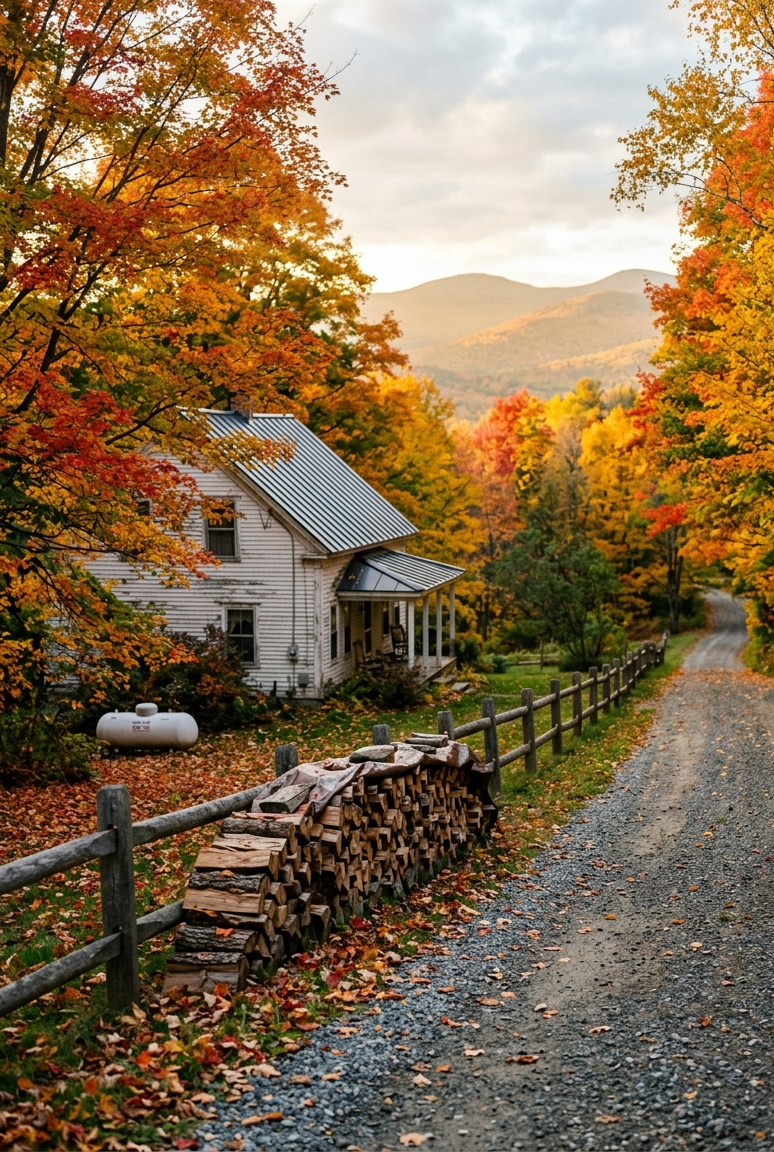
Last October I stood in my driveway watching the propane truck top off the tank, doing that quiet math every Vermonter does around the same time every year. Winter is coming, the tank needs to be full, and the bill is going to sting a little. A friend from outside Boston texted me that same week asking about moving to Vermont, wanting to know if it would actually save her any money compared to staying put in Massachusetts.
It is a question I get a lot, usually from people who picture Vermont as the “cheap and quiet” alternative to the rest of New England. The real answer is more nuanced than that, and it depends heavily on which state you are comparing us to and which town you are looking at.
Is it more expensive to live in Vermont than other New England states?
Vermont sits in a strange middle spot. We are not the most expensive state in the region, not even close, but we are also far from the cheapest. Housing here runs above the national average, heating costs are real, and property taxes are on the higher end nationally.
At the same time, Vermont tends to look downright reasonable next to Massachusetts and holds up fine against New Hampshire and Connecticut, depending on the town. Maine can go either way, since coastal Maine has gotten expensive while the northern counties remain some of the most affordable in New England.
So when someone asks whether living in Vermont is expensive, my honest answer is: expensive compared to the country, moderate compared to our neighbors.
How does Vermont’s cost of living compare to New Hampshire?
This is the comparison I hear most, mostly because people assume New Hampshire wins automatically since it has no state income tax. It is not that simple once you look at actual home prices.
Vermont’s statewide median home price has been running somewhere in the low to mid $400,000s, while New Hampshire has been trending noticeably higher, often in the high $400,000s to near $500,000 depending on the month and region. Southern New Hampshire towns near the Massachusetts border and the Seacoast area carry a real premium because of their easy commute into Boston.
New Hampshire wins on income tax and sales tax simplicity. Vermont tends to win on land, older farmhouses, acreage, and a slower pace that a lot of relocating families are specifically chasing. Buyers who want privacy, a dirt road, and a view usually find more of it for the same money on our side of the Connecticut River.
Is Vermont cheaper than Massachusetts?
Almost always, yes, and this is the comparison where Vermont looks the most affordable by a wide margin. Massachusetts median home prices have been sitting well above $600,000 statewide, and that number climbs fast once you get anywhere near Boston, MetroWest, or the coast.
A lot of the people relocating to Lamoille County right now are coming from exactly this situation. They are selling a home outside Boston, and even after buying something nicer in Stowe, Morrisville, or Cambridge, they are walking away with meaningful equity left over.
Vermont’s tradeoff is obvious too. You are giving up density, restaurant variety, and big city job markets. What you gain is space, quiet, and a housing dollar that stretches noticeably further.
What about Maine and Connecticut?
Maine is the trickiest comparison because the state is so split. Coastal Maine, especially around Portland and Cumberland County, has become one of the more expensive corners of New England. Inland and northern Maine, on the other hand, remains genuinely affordable, sometimes more affordable than rural Vermont.
Connecticut ends up landing close to Vermont on paper, with statewide home values in a similar range. The experience feels different though. Connecticut’s cost of living leans more suburban and commuter driven, tied closely to access into New York City and Hartford, while Vermont’s costs are shaped more by land, heating, and small town infrastructure.
Rhode Island is smaller and denser than all of these, and tends to price similarly to Connecticut once you account for its coastal premium.
What does it actually cost to heat a home in Vermont?
This is the line item that surprises transplants the most, and it is worth being honest about it. Between November and April, a typical Vermont home can run anywhere from a couple hundred dollars a month up into the $400 to $500 range, depending on the size of the house, the insulation, and whether you are heating with oil, propane, or wood.
Plenty of people up here have shifted to heat pumps or wood and pellet stoves to soften that seasonal spike. I know several families in Hyde Park and Johnson who split their heat between a wood stove and a mini split system, which keeps the propane truck visits fewer and further between.
This cost exists in New Hampshire and Maine too, but it is worth budgeting for specifically if you are coming from somewhere with milder winters, since it is not always factored into someone’s first year of Vermont cost projections.

Which Vermont towns offer the best value right now?
Lamoille County is a good example of how much variation exists inside one small region. Stowe carries a resort premium because of the mountain and the tourism economy. Drive twenty minutes in almost any direction and that premium starts to soften.
Morrisville and Hyde Park tend to offer more house for the money while still keeping you close to Stowe’s amenities and the ski hill. Johnson and Cambridge have their own quieter, more agricultural character, often appealing to buyers who want land and a slower rhythm without giving up proximity to the Lamoille Valley Rail Trail or the Green Mountains.
- Stowe: resort town pricing, strong long-term value, higher taxes and insurance
- Morrisville and Hyde Park: more affordable, still close to skiing and downtown Stowe
- Johnson and Cambridge: rural character, more acreage per dollar, quieter pace
Why do people still choose Vermont, even with the higher costs?
This is the part that numbers alone never fully explain. People who move here are usually not chasing the cheapest option on a spreadsheet. They are chasing something closer to a feeling, the kind you get watching fog settle into the valley from Route 15, or picking up cider donuts at a farm stand that has been in the same family for three generations.
Vermont’s version of Vermont lifestyle costs more, but it also delivers something that is getting harder to find elsewhere in New England: small towns that still feel like communities, mountains that are actually part of daily life rather than a weekend destination, and a pace that lets people breathe.

So is moving to Vermont worth the cost?
For a lot of the families and remote workers I talk to, the honest answer is yes, especially compared to Massachusetts or the pricier parts of Connecticut and coastal Maine. For someone strictly optimizing for the lowest possible tax bill and the cheapest home price in the region, New Hampshire or inland Maine may win on paper.
What Vermont offers instead is a kind of value that does not show up neatly in a cost of living calculator. It shows up in the length of your commute, the number of times you actually use your porch, and whether your kids know their neighbors’ names.
Every fall, that propane truck still shows up in my driveway, and every fall I stil think it is worth it.
Leave a comment